Today on a layover I rode the Mule one mile on US 60 near Frankfort, Kentucky. It ain’t much but that makes 35 states ridden in.
Next one should be Wyoming sometime in late June.


Today on a layover I rode the Mule one mile on US 60 near Frankfort, Kentucky. It ain’t much but that makes 35 states ridden in.
Next one should be Wyoming sometime in late June.
The tour is in two parts. The solo part goes from Saint Louis, Missouri to Colorado Springs, Colorado. The team route goes from Colorado Springs to the Oregon Coast following the Adventure Cycling TransAmerica Route.
For the solo part of the tour, I decided to ditch Nebraska, Arkansas, and Oklahoma. The plan is to do the Katy Trail from O’Fallon, MO to Clinton, MO. Then take a couple of days to get to the TransAmerica Route at Ash Grove, MO. I’ll take the TransAm west to Hutchison, KS. Next I leave the TransAm to check out the Gyp Hills Scenic route between Medicine Lodge and Clearwater. I will angle back to the TransAm at Scott City then head west to Pueblo CO. From Pueblo it’s one day north and about 3,000 feet up to Colorado Springs. The dates below assume I don’t take any days off but I will almost certainly take at least two. Ash Grove is a free, indoor place to stay. There are any number of small towns on the TransAm west of Scott City that have free camping or indoor accommodations.
It’s pretty common for small towns in the plains, especially those on the TransAm, to have free camping for bike tourists in city parks. Hutchinson, KS and Sheridan Lake (not show, but it’s near Eads) in eastern CO have free indoor camping at churches. I am not anticipating using Warmshowers (a community of people who host bike tourists for free) because of Covid concerns.
| Day | Date | Start | End | Miles | Cumulative Miles | Sleep? |
| 1 | May 22, 2022 | O’Fallon, MO | McKittrick | 60 | 60 | B&B/City Park Camp/Motels |
| 2 | May 23, 2022 | McKittrick | Hartsberg | 66 | 126 | B&B/City Park Camp/Motels |
| 3 | May 24, 2022 | Hartsberg | Pilot Grove | 53 | 179 | Town park camping/ B&B |
| 4 | May 25, 2022 | Pilot Grove | Clinton | 63 | 242 | Hotel/Camping Sparrowfoot |
| 5 | May 26, 2022 | Clinton | Stockton | 55 | 297 | Hotel/Camping Crabtree Cove |
| 6 | May 27, 2022 | Stockton | Ash Grove | 40 | 337 | City Park Camp |
| 7 | May 28, 2022 | Ash Grove | Pittsburg KS | 72 | 409 | Hotel/camping |
| 8 | May 29, 2022 | Pittsburg KS | Chanute | 60 | 469 | Motels/City campground |
| 9 | May 30, 2022 | Chanute | Eureka | 62 | 531 | Motels/City campground |
| 10 | May 31, 2022 | Eureka | Newton | 72 | 603 | Motels/City campground |
| 11 | June 1, 2022 | Newton | Hutchinson | 47 | 650 | Church Camping/motels |
| 12 | June 2, 2022 | Hutchinson | Pratt | 56 | 706 | Motels/Camping |
| 13 | June 3, 2022 | Pratt | Medicine Lodge | 30 | 736 | Motel/Camping? |
| 14 | June 4, 2022 | Medicine Lodge | Greensburg | 67 | 803 | Motels/Camping? |
| 15 | June 5, 2022 | Greensburg | Cimarron | 65 | 868 | Motel/Camping? |
| 16 | June 6, 2022 | Cimarron | Scott CIty | 70 | 938 | City Park. Motel. Hostel |
| 17 | June 7, 2022 | Scott CIty | Tribune | 47 | 985 | City Park |
| 18 | June 8, 2022 | Tribune | Eads, CO | 58 | 1043 | City Park/Motel |
| 19 | June 9, 2022 | Eads, CO | Ordway | 65 | 1108 | City Park/Motel |
| 20 | June 10, 2022 | Ordway | Pueblo | 55 | 1163 | All |
| 21 | June 11, 2022 | Pueblo | Colorado Springs | 51 | 1214 | All |
| Daily Average | 57.8 |
The Pile
I have been building the pile o’stuff for my tour. It’s getting pretty big. In a couple of days I’ll stuff it all into the panniers, load it on the bike, and try not to crash from the sheer enormity of it. At this stage, I keep thinking of things to bring like butt wipes and little bottles for castille soap and chain cleaner. (I hope I don’t mix them up. Could make for an interesting laundry or bathing experience.) There’s also a small jar of peanut butter. And a bigger camp towel. And clothing. I am debating whether to bring allen keys and a chain brake. If I do I may leave my multitool at home. It’s a pain to use. Another item that may get left behind is my water bladder. I used two in the deserts of Utah and Nevada but they were hard to use. In any case, I should have no trouble finding bottled water along the way. The U-lock is for use before the trip. I’ll use a lighter Ottolock for the road. You may also notice a Covid quick test kit in the pile. I’ll organize the small items into Ziplock bags, one for tools, one for medicines, one for maps, one for toiletries, etc.

Of course, every tour begins with too much stuff. Then, after a week of slogging all this up hills, I’ll go to a post office and mail thing home.
The Route
My original plan, Plan A, has been to follow the Adventure Cycling Association’s Lewis and Clark Trail to southeastern Nebraska. This would involve about 200 miles on the Katy Trail, an off road route, then country roads along the Missouri River. The route continues across Nebraska before angling down to Colorado Springs where I meet up with Mark and Corey. This first part of the trip is about 1,000 miles. The three of us will follow the Transamerica Route up to Yellowstone then eventually to the Oregon Coast, another 2,000 miles.
The other night I mapped out a more southerly route. Using Plan B, I’d stay on the Katy Trail to the end in Clinton, Missouri. Then head south to Bentonville, Arkansas. Next I’d head west into far northeastern Oklahoma before angling up to Medicine Lodge, Kansas. There is a road through the Gyp Hills from Medicine Lodge to Coldwater that is supposed to be one of the best cycling roads in the country. After Coldwater I could ride to Dodge City because cowboys, Wyatt Earp, and buffalo hunters. From Dodge I’d angle up to Pueblo, Colorado then up to Colorado Springs.
There are several drawbacks to this route. It looks pretty hilly getting to and from Bentonville, for a start. Also, I can’t find much in the way of cheap or free accommodations on this route. I’d be hopping from one hotel or motel to another. It’s also over 300 miles and five days longer than Plan A.
Plan C is pretty simple. Ride the Katy Trail to Clinton. Then ride two days south to Ash Grove, Missouri which is on the Transamerica Trail. There’s a guest house there with a pool that welcomes bike tourists. (This is where I met Corey and Mark in 2019.) I would just take the Transamerica Route west to Pueblo as I did in 2019. There are three very big advantages to this. Nearly every town on the route has free camping or cheap hotels. The TransAm is the oldest long distance route in the US, so people who live along it expect to see bicycle tourists. And, probably most important, I’d be certain to encounter other bike tourists who can offer help, information, and companionship across the rather boring plains.
A final idea is to use the Katy and TransAm to Hutchison, Kansas, northwest of Wichita. Then I could angle southwest to Pratt. From Pratt I’d go due south to Medicine Lodge. Then the scenic road Gyp Hills road goes straight west to Coldwater. After which it’s a couple of days northwest to Dodge City. From Dodge it looks pretty straightforward to ride back to the TransAm at Scott City.

The Body and the Brake
In 2019, I did my ride from north central Indiana to San Francisco on one good leg. My left knee and hip were aching most of the way. It didn’t help that my front brake pads rubbed most of the way.
In 2022, the knee, hip, and brake problems are fixed. Alas, I am now 66 years old with an 86 year old back. I kind of like to think along the lines of Augustus McCrae: the older the violin, the sweeter the music.
Preparations for the tour continue. I heard from Mark of the team of Mark and Corey yesterday. He said we’ll see each other in 5 1/2 weeks “hopefully”.
A lot can happen in 5 1/2 weeks. And a lot can happen during a bike tour. I’ve been very lucky so far on the usual bad stuff like crashes, tornados, snow, robberies, and such. Of more immediate concern, of course, is Covid.
I’ve been using cloth masks since the start of the pandemic. I’ve also been careful to avoid enclosed spaces and crowds. Last night I took my wife out for dinner where we ate inside.
Despite a few exceptions such as this dinner, I’ve been a virtual hermit during the pandemic. As far as I know I haven’t contacted Covid yet. (Nor has my wife or daughter.) One interesting benefit of this isolation is that I also have had almost no other illnesses for two years. And I’ve learned that masking is a pretty effective way to avoid pollen-related allergy symptoms. (The DC area is particularly brutal for pollen sufferers.)
The tour will take away from my DC area bubble where people are still using masks to a significant extent. In the last few months mask usage even here tree has declined. And Covid cases are on the rise once again.
I’m heading into areas where mask usage is low. I intend to continue masking because a Covid infection could be disasterous. I imagine having breathing difficulties at 9,000 feet without a hospital anywhere nearby. (Hello, Wyoming!) I decided to buy a couple of N95 masks as a precaution.
I rode to the drug store and began an aisle-by-aisle search. I could only find cheap disposable cloth masks on display. Discouraged I started to leave the store when a message came over the store PA system. “Customers, you can get free N95 masks at the check out. Three per customer.” The check out clerk happened to be standing nearby so I asked him for some. He led me instead to a large stack of cardboard boxes in the entryway of the store. I had walked past them without a glance on the way in.
The boxes were filled with large bunches of disposable N95 masks in plastic bags. I was about to take three when the clerk said “Here. take a bag. Give them out to your friends.” I was flabbergasted. I came home with about 25 masks. I tried one on. These babies rock. They fit tight to your face and they are not at all restrictive of breathing. They are a bit awkward to wear so I expect I’ll only use them in hotels and food stores.

I am down to only a handful of tasks.
It’s been raining for two days. Yesterday we had cold down pours with thunder and such. Today, has been a nonstop cold, windy mist. I didn’t ride. I have nothing to prove to myself. Instead of riding, I went for a 1 1/2 mile walk to test my back. I had an epidural injection on Monday so I was curious to see if it made any difference. (For what it’s worth, my pain doctor referred me to a back surgeon so she’s not exactly the picture of optimism.)
I used a single trekking pole and my Hoka bouncy shoes. My gait was much improved. I didn’t have the awkward forward lean and I didn’t feel off balance. I managed 1/2 mile with no discomfort at all and the pain level never rose above a 2 on a scale of 1 to 10. I’m pretty pleased. I am bringing a trekking pole with me on my bike tour.
Before my walk I was visited by our local postman. He had me sign for a document that I have been waiting for since January.
I am now free to move about the continent.
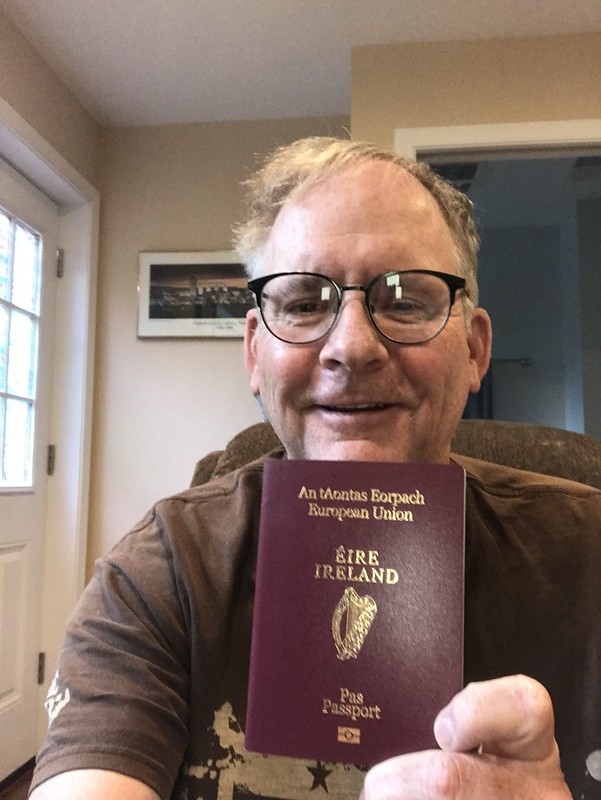
I am awaiting my supporting legal documents but with this EU passport and my US passport card, I can go pretty much anywhere on any conveyance.
I started this process about 4 or 5 years ago, amassing paperwork to prove my lineage. I sent my application off in 2019 or 2020. There were delays related to the pandemic (the passport office actually closed) and the Brexit passport rush. Processing began in earnest in January 2022 and backlogs still delayed my passport by an additional month. It’s good for 17 years for some reason. I’ll be gumming my fish and chips by then.
Pass the Guinness lads.
I just realized that around my house when we use the word “prep” it conjures up the cleansing that precedes a colonoscopy. Well, that’s entirely different from tour prep. Colonoscopy prep involves getting rid of, um…, stuff; tour prep involves amassing stuff. (Touring involves shedding stuff, but that’s another story.)
Today was a miserable rainy day here in the DC area so it was a good time to make a trip to REI for some goodies. I bought a summer weight Buff (for sun and bug protection), a 10,000 mAh (milliampere hour) capacity USB power pack, two pairs of socks, and a new Swiss army knife. The power pack has nearly four times the capacity as the one I’ve used in the past. The Swiss army knife does not include the useless scissors that broke about 25 years ago on my last knife.
When I got home I realized that I need a new, bigger lightweight camp towel so I’ll just have to ride back when the rain stops. Also, I found two perfectly good pairs of socks that had gone underground in my sock drawer. I can always use more socks I suppose. I had over $45 in rebates coming to me at REI so the sting of the shopping excursion was lessened considerably.
Other than the towel, all I need is a smaller plastic squeeze bottle for my castille soap. There’s no reason to carry a pint of concentrated soap. I can always buy more on the way. (I would have bought two four ounce bottles at REI but they were scented and I don’t want to smell like bear lunch when I am camping.)
The Weather Channel app told me that the rain would stop from 1 to 4 pm today so I went for a ride. Sure enough, four miles into the ride the skies opened with a cold, hard rain. Thunder. Lightning. What fun! Oh well, I managed to survive it in good shape aboard my Cross Check.
My last post included a packing list. Of course, since I wrote it I have thought of a few things to add. After watching more tent videos last night (my tent seems to get a lot of positive reviews), I decided I’d better bring more tent stakes. Because of the deep vein thrombosis (i.e. blood clot) in my left calf a few years ago, I need to wear a compression sleeve on that leg from time to time. So into the pile it goes. On my 2019 tour, I bought a pair of sweat pants to wear in my tent on cold nights. I never used them on the tour but they are hella comfy. Do I bring them? Do I ditch my rain pants and the sweatpants and bring my Hybrid Cycling Pants instead?
I am bringing a worn out t-shirt acquired during my 2017 tour. I will wear it a few times before it becomes my chain rag. This will meet with Mrs. Rootchopper’s approval as I tend to wear clothing well after it should be thrown out.
A couple of questions keep coming up, so at the risk of repeating myself here are some responses.
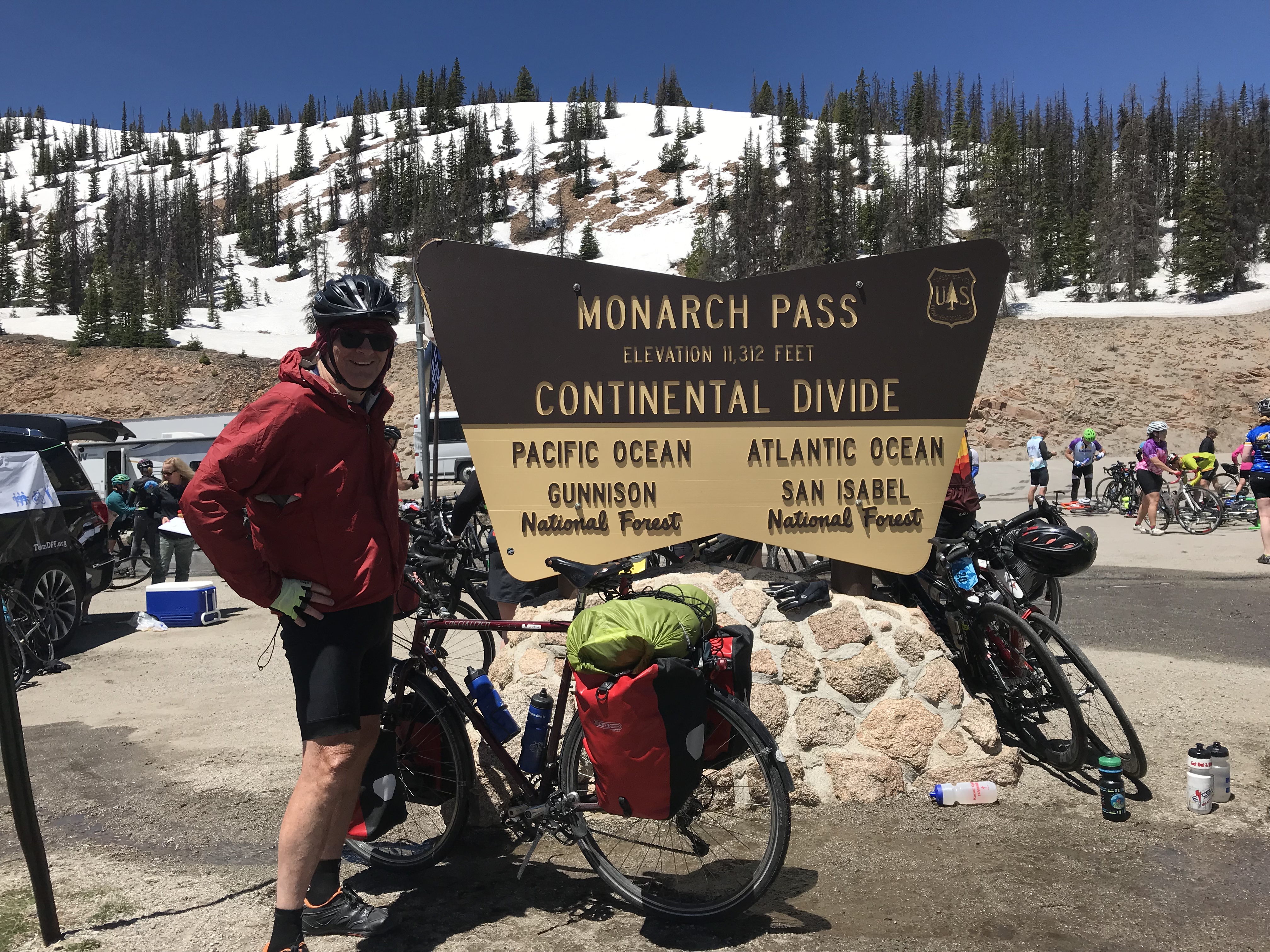
What does all this stuff look like on the bike? I have a picture from my 2019 tour and the 2022 load will look pretty much the same. Two small panniers down low, in front. Two bigger panniers in the back. A dry bag with tent and sleeping pad on the rear rack. And, obscured by that handsome dude in the picture below, a handlebar bag. Heavy stuff up front. Light stuff in the back. Anything I need to access during the day also goes up front.
Where are you going? The tour is in two parts. The solo part, about 1,000 miles, starts just northwest of St. Louis. I’ll follow the Katy Rail Trail most of the way across Missouri before angling northwest past Kansas City in the general direction of the Missouri River. In Falls City Nebraska, I will head west until I get sick of Nebraska, then angle back across northwest Kansas to Colorado Springs (just north of Pueblo, in the map below). If the Missouri is flooding, the Katy Trail likely will be unusable. Plan B will be to ride Route 66 and more or less replicate my 2019 tour in Missouri and Kansas. This route would include a dip into Arkansas and Oklahoma. And later, the Gypsum Hills Scenic Byway (Highway 160) in southwestern Kansas. This was listed as one of the 30 best cycling roads in the US. After that, I’d ride through Dodge City. This part of the tour should take 17 – 20 days. I’ll arrive a week or so ahead of Mark and Corey whom I will join for the second part of the trip.
From Colorado Springs, Mark, Corey, and I will head west (somehow) to the TransAmerica Trail. Somewhere in the high Rockies to the west we’ll pick up the trail and head north to Wyoming. Then it’s northwest to Grand Teton and Yellowstone National Parks, Idaho north to Missoula, Montana. In Missoula we turn southwest through Idaho again and finally cross central Oregon to the Pacific Coast. The distance is about 2,000 miles.

One good rule about long distance bike touring is: Ignore the totality of the thing. Think in terms of mornings and afternoons. 30 miles by lunch, another 30 in the afternoon. It’s just two round-trip commutes to the office. Oh wait, I’m retired. Never mind. You get the point. With 12 hours of daylight, all you have to do is average 5 miles per hour. No problem. For 50 days. Eek.
If the miles don’t get me, the mountains will. YOLO.
Based on my 2017 tour, I pulled together a packing list. Items in italics are likely to be dropped. Most of this stuff is small. I can’t help but laugh that the medication list keeps growing.
Electronics
Clothing
Personal Items
Miscellaneous
Camping Gear
Medicines
It all has to fit into four panniers (two small in front, two large in back), a handlebar bag, and in a drybag on top of the rear rack. Heavy stuff goes up front. Things I need to access while riding go up front and in my handlebar bag. Clothes, camping gear, anything not needed for the day’s ride go in back.
Some of these things are consumables. Speaking of consumables, I’ll be bringing food along the way. Peanut butter (or refried beans) on tortillas is compact and light. I also eat a lot of apples, partly because motel breakfast bars have them. I’ll bring a couple of energy bars for emergencies.
I think I have all these things except for the Swiss Army knife and the power pack. I’ve used a very small power pack in the past but I can get one with near 5 times the capacity for less than $30. Might as well.
I have been ramping up my preparations for my bike tour this summer. I’ve finished all the work around the house that I can tolerate. (The to-do list is never-ending.) Here’s a short list of stuff I’ve been doing.
Bike and Body
Over the winter I had the good folks at Bikes at Vienna work on The Mule. They replaced the crummy front brake, both tires, the chain, and cassette. Ready to rumble.
I had horrible pain in my left hip and knee during my 2019 tour. It became much worse when I started climbing across Colorado, Utah, Nevada, and California. Only cortisone injections would calm the pain. So it was discouraging that my left hip started back up when I took The Mule out for test rides over the past two weeks.
I took out a tape measure and compared all the distances between saddle, bottom bracket, and handlebars to those on the Cross Check which does not cause the hip and knee issues. Then I did my best to configure the saddle height and fore/after position to mimic the Cross Check. Within a day, my hip pain went away. I want to experiment a bit more with a slightly higher handlebar but I’m confident that I have hit the sweet spot.
Since I have switched to riding in shorts, my riding has become much more efficient and comfortable, which is not to say that I am fast. Far from it. Over the last two years I dialed back working out to spare my body, sore from spinal stenosis, the stress. I seemed to have emerged rather more pear-shaped. My waist is much bigger and my shoulders and upper back muscles seem to have vanished. Despite this distressing development, I seem to be able to climb hills on my bike with less effort. Maybe lowering my center of gravity was fortuitous outcome of pandemic sloth.
Tents and Gear
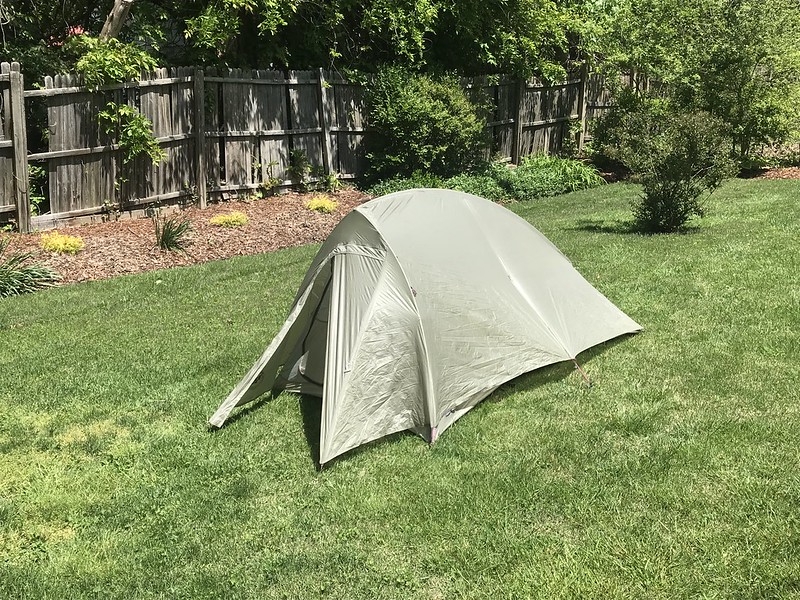
I am a bit behind with my packing. I spent several days comparing the two tents we have at home. My daughter has a two-person Kelty Escape tent that she has used at two Bonnaroo music festivals. I tried it out in the backyard. It’s ROOMY! I love it. Alas, it’s heavy as an anvil.
During my 2019 tour my REI tent finally died after 16 years of service. It was roomy and comfy and even had a nifty inside rainfall feature. No amount of seam sealer applications could solve this so I bought a Big Agnes Ultralight Fly Creek tent to replace it. Unlike the other two tents this one is not free standing, meaning it doesn’t work properly without being staked into the ground. I only used it about four times during the tour and could not for the life of me figure out how to set it up to my satisfaction. The single spine pole that supported the top of the tent would always flop to one side. The interior side walls of the tent would sag. It felt like sleeping in a coffin.
A couple of nights ago I watched several YouTube videos on how to set up the tent. It turns out there are a few tricks. First. stake out the four corners of the tent. Then use the poles to establish the tent structure. No flop at the top! Next put on the rain fly reusing the stakes on the corners. There are clips and straps on the underside of the rainfly that attach to the sides and top of the tent. Connect all these and tie them down with stakes on either side of the tent. The guy-wires of the tent all have these odd little plastic tensioners on them. The videos solved the puzzle on how to use them to adjust things. Damned if they didn’t work well.
Some other tricks I learned. The stakes should be placed at a 45-degree angle to the ground with the tops pointing away from the tent. The stakes should be set on opposite sides in sequence. Do one corner, then the opposite corner; one side then the opposite side. This creates harmony in the tent universe. Finally, use the tent backwards. In other words, sleep with your head next to the door at the end of the tent. This is where the tent is tallest.
After a few tries I got the hang of it and the tent is pretty darned nice. It also weighs a good four pounds less than the Kelty. Weight will matter a lot in the mountains so this is a good thing.
Back Pain
I have received another epidural injection for back pain a few days ago. It doesn’t seem like it did much. My physiatrist is recommending that I talk to a back surgeon. This will wait until I get back from the ride. There’s no point in discussing it now. Unless my condition improves, I’ll be looking at surgery next December and recovery over the cold winter months.
My pain doctor gave me a prescription for gabapentin. This gives me mild relief by extending the amount of time I can spend on my feet without pain, perhaps by 20 – 30 minutes. The only way to get rid of the pain is to do physical therapy (basically gentle yoga on the floor) or simply sit down for a few minutes. Riding my bike doesn’t bother my back at all.
The Packing List
I don’t have a packing list written down but I do know what to bring. One thing I am not bringing is my metal mesh bag. I’ve been carrying this around for all my recent tours to keep critters out of my food and have only used it once. I’ll bring string and hoist a pannier instead. (And use bear boxes when necessary.)
I need to get a bigger back-up battery for my electronics. I have a small one but can buy one with four times the juice for $40. I also need a new Swiss army knife because my 45 year old knife was lost after I used it in the garden opening mulch bags.
I am bringing some Adventure Cycling Association maps for routes near my planned trip route and for Oregon. They may be useful.
Pannier Test
Sometime in the next couple of nights I am taking a flashlight and searching for holes in my panniers. I have ten bags, four small and six large, to choose from. They are all Ortlieb roll top models but have been beaten up pretty bad by decades of commuting, errand running, and touring. Once I find the two small ones and two big ones with the fewest holes, I’ll break out some duct tape and repair them. I’ll also use kitchen plastic bags as a back up.
Passport
I applied for an Irish EU passport in January. It was supposed to be completed in early April but there is apparent no efficiency quite like Irish bureaucracy. Today I learned that my passport has been mailed. My application included my US passport and my Certificate of Foreign Birth (my Irish citizenship) and I will be relieved when they are returned in the coming days.
Filling the Bare Spot
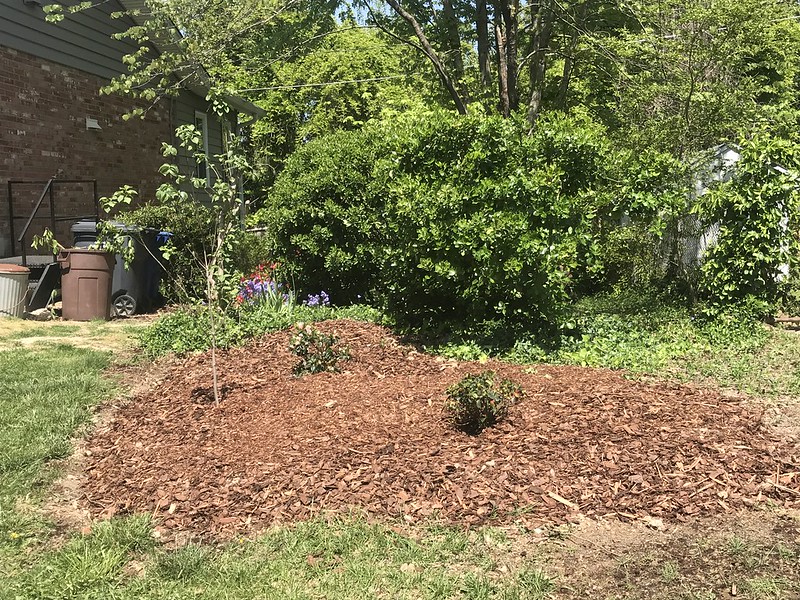
A couple of years ago we lost our last pine tree. It was part of a stand of two pines and five cypress trees. The cypress trees all succumbed to snow loads over the course of a ten year period. Then a blight of some sort took out the pines. After two years of looking a big bare spot where the pines once stood, I finally decided to dig out the vines and roots and other junk and plant something where the pines once stood. Two azaleas and a dogwood are now planted amid a whole mess of pine bark mulch. This took at least five hours over two days to accomplish.
Bike Summary
It was a pretty mellow month as far as bike riding is concerned. I rode 774 1/2 miles quite a bit less than last year, but, in my defense, I did take five days off. All my bikes are now ready for the summer after some TLC at bike hospitals. The Mule is tour-ready. Big Nellie is out of the basement. The Cross Check has a new rear wheel. Little Nellie gathers dusts. (Anybody want to buy a lightly – okay, over 20,000 miles) used folding travel bike?)
My longest ride of the month was yesterday. I rode 53 miles on Big Nellie through the azaleas and dogwoods in Bethesda. Dang, if that neck of the woods doesn’t have awesome landscaping.
So far this year, I have ridden 2,824 miles. That’s an average of 23 1/2 miles a day and a 8,590 mile yearly pace.
Tour Prep
I am starting to prep for my bike tour in earnest. Today was the tent competition. I have a lightweight backpacking tent and my daughter has a heavier, inexpensive tent. The heavier tent is roomier and is free standing. I will be sleeping in it tonight to make sure my back can take sleeping on the ground.
I need to acquire a few goodies for the tour. I would like to have a bigger back up battery for those days when my phone runs down. I also need some all purpose soap (like Dr. Bronner’s). I think my last task will be to inspect my panniers and patch the holes in them. Duct tape to the rescue.
Reading and Watching
I’ve been watching baseball games nearly every night since the season started. The Nationals are pretty lame this year. Cold weather has kept me from attending any games. I might get one in before I leave for the tour.
We did a quick trip up to Harford to visit our daughter who is finishing up her first year in law school. We went to a Yard Goats minor league baseball game, ate some Frank Pepe’s pizza, visited Mystic Aquarium, and ate at Dunkin Donuts. Mission accomplished.
My wife and I are watching Moon Knight, a Marvel series on Disney+. It is bizarre to say the least. Oscar Issac, Ethan Hawke, and May Calamaway are all very good. I can’t help but wonder what they were thinking when they first read the script. My guess is WTF?!
I read only two books: Lola and Vida, the fourth and fifth books in the Diva series by Delacorta. They were okay. One more to go (Alba).
Over the weekend we travelled to Hartford to hang out with our daughter who is attending her first year of law school. On Saturday night we caught a minor league baseball game at Dunkin Donuts Park, known to all as The Dunk. It’s a new ballpark, very well designed and maintained. Minor league baseball is a trip. This was fireworks night so we could only get standing room tickets. Not a problem at $10 a pop.
The AA game pitted the hometown Hartford Yard Goats, the AA affiliate of the Colorado Rockies, against the Somerset Patriots, the oddly named New York Yankee farm club. The teams were competitive. The play was competent. What was more interesting was the endless and creative marketing that went on during the game. After every strike out for example, the announcer said words to the effect “That’s another strike out for addiction” referring to some local program related to drug addition recovery. What a weird promo!
In between every inning there was a contest pitting kids against each other. One contest featured to two two teams of two. One player, with his back to his teammate, would toss a chicken wing up in the air and his partner had to catch it in a bucket he held on his head. No lie.
Another contest was a race between two kids who raced to put on fire department pants, jackets and helmets. Then run to the finish line.
The best was the Baby Goat Race. A bunch of cute little kids dressed up in what looked like pajamas raced around the infield on the outfield grass. They had little goat heads attached to their PJs. Total sports excitement.
The post-game fireworks were quite minor league in keeping with the scope of things. They were still entertaining though. Ooh. Ahh.
The whole night had a joyous, small town, middle class, feel to it. The crowd was whiter than Ivory soap which was a bit of a shock considering the city of Hartford’s ethnic diversity. The stands below our SRO perch were filled with grade school kids. They had a ton of energy. Not one of them watched the game.
The game featured a pitch clock. Once the pitcher got the ball, he had 12 second to throw it. Otherwise the late pitch would be called a ball. When a runner was on base, 18 seconds were allowed. In between innings the clock was set to 2 minutes. Relievers had two minutes to throw their first pitch. The game lasted a bit over 3 hours but the pace was noticeably brisker than a major league game. It would have been shorter but for numerous pitching changes. If you ever see a major league game played in the 60s or 70s you’ll notice the pitchers and batters don’t mess around. Batters stay in the batters box. Pitchers don’t go for long contemplative trips around the mound. This minor league game was like that.
As for the refreshments, The Dunk has pretty much everything. It has a very popular barbeque vendor in left field. We stood near it and there was a long line throughout the game. There were local craft beers on sale as well as the usual baseball munchies, hot dogs, popcorn and such. And, of course, coffee and donuts because Dunks.
Oh, did I mention the highest point in the ballpark has a Dunkin Donuts coffee cup on it.
For those of you unfamiliar with southern New England Dunks are everywhere. It’s insane. Of course, we managed to eat breakfast at one in West Hartford. When in Rome…
One life, some bicycles. A million possibilities, zero clue!
Information and news from David Goodrich, author of A Hole in the Wind.
Coast-to-coast US bike tour
Exploring Nevada's backroads by bicycle
Just another manifestation of my obsession with riding
Around Eire on Frida, Bike Friday
Follow my Journey!
just a girl on a mission to pet every puppy in the world. #stillatourist
Two travelers on two tires
The Weston Front - the destination of a road less travelled...
One step, then one step more
Riding the South Coast of Massachusetts and Rhode Island
Welcome To My Adventures
 A Few Spokes Shy of a Wheel