Updates on the Pedal Off, Phantom Bike Problems, and Nerve Pain

Pedals

I put the MKS lambda pedals on my CrossCheck. After some fiddling with my saddle position, I rode them for a week and liked them a lot. I especially like not having to deal with toe clips while wearing my winter footwear. The only downside is that my feet can slide off of them on bumpy surfaces.

My Pedaling Innovation Catalyst pedals went on my Specialized Sequoia. To start, I did saddle adjustments similar to the ones I did on the CrossCheck. I liked the pedals but they seemed to be underwhelming relative to the rave reviews I’d been seeing online. I re-read the instructions from the manufacturer and started over. I returned my saddle to the pre-Catalyst position and lowered it about one centimeter. On my first test ride, after 15 miles the magic started to happen. After 30 I was very, very pleased but thought that maybe the improvement was all in my head. My second ride was in cold (34 degree) weather. I normally ride slower to conserve body heat but I was riding noticeably faster. I kept checking the wind, thinking I had a tailwind. No. There was no pressure on the undersides of my feet and my feet felt like they were locked to the pedals. I had only intended to ride 20 miles but I ended up riding 33 and could have gone much farther. They performed exactly as advertised.

Conclusion: I am in like with the Lambdas but in love with the Catalysts. I think sometime this spring I’ll move the Lambdas to my Bike Friday. Then I’ll decide whether to buy Lambdas with pins (called Gammas or Kings or Monarchs depending on who is selling them) or another pair of Catalysts.

Phantom Bike Problems

About a month ago I had a flat on my CrossCheck. I couldn’t find anything wrong with the tube or tire so I assumed it was a valve issue. I changed the tube and all is well.

A week ago I had a flat on my Sequoia. (I’m not loving this trend!) Once again I meticulously searched for a cause and found nothing. I put the tube back in the tire and all is well. Go figure.

A few days ago the bike computer on the Sequoia started to fail. The computer itself was sound but it was not receiving a signal from the sensor on the fork. I fiddled with the sensor and it started working again. The next day the same thing happened. No signal. It being a discontinued model, I decided to buy a new computer. Like the old computer this one allows me to input my mileage and will record up to 99,999 miles. Of course, between the time I ordered the new computer and the time it arrived my old computer started working fine again.

Nerve Pain

Last month I went to a hand surgeon for relief of trigger finger on the middle finger of my right hand. He gave me a cortisone shot that, after about three weeks, seems to have solved the problem. A further examination led him to conclude that I have carpal tunnel syndrome (CTS) and likely a pinched nerve in my neck. He sent me to a neurologist for an electromyography (EMG) test. I had the test today.

I had an EMG once before for leg and back pain. It was extremely painful and its results were inconclusive. As you might imagine I was dreading today’s test but it turned out to be about as painful as a series of static electricity shocks. No big deal. The results were that I have mild CTS in my left hand and moderate CTS in my right. The neurologist said she didn’t have any findings about my neck. (Since it is obvious to me that I have a nerve impingement in my cervical spine, I find this conclusion to be dubious.) In any case, I go back to the hand surgeon in three weeks to discuss next steps. Since I can (obviously) type and do just about anything else without pain, I am not opting for surgery. Moreover, I found that the saddle adjustments to my CrossCheck and Sequoia, along with the deep tissue massage I had last month, have coincided with reduced neck pain. I have come to the profound medical conclusion that I am old.

The Great Pedal Off

Having ridden pedals with toe clips for over 45 years, I decided it was time to experiment with platform pedals. There were three pedals that caught my eye. MKS Lambda pedals, rather than having a rectangular shape, look rather like a big “8”. These are the pedals that Mat Ryder used on his two long US tours. They differ from the other two platform pedals of interest in that they do not have pins sticking up out of the surface. The pins keep your foot in place, except when they don’t. If your foot slips and you take a pinned pedal to the shins, there will be blood. I don’t like blood.

The other two pedals have pins. MKS makes a pinned version of the Lambda under a variety of names: Gamma, King, and Monarch. They are very similar to each other. This being the end of the biking season they were hard to find. So I settled on the Lambdas. Note that MKS is the same company that makes the pedals I have been using on my CrossCheck and my Specialize Sequoia. They’ve held up very well for well over 7,000 miles.

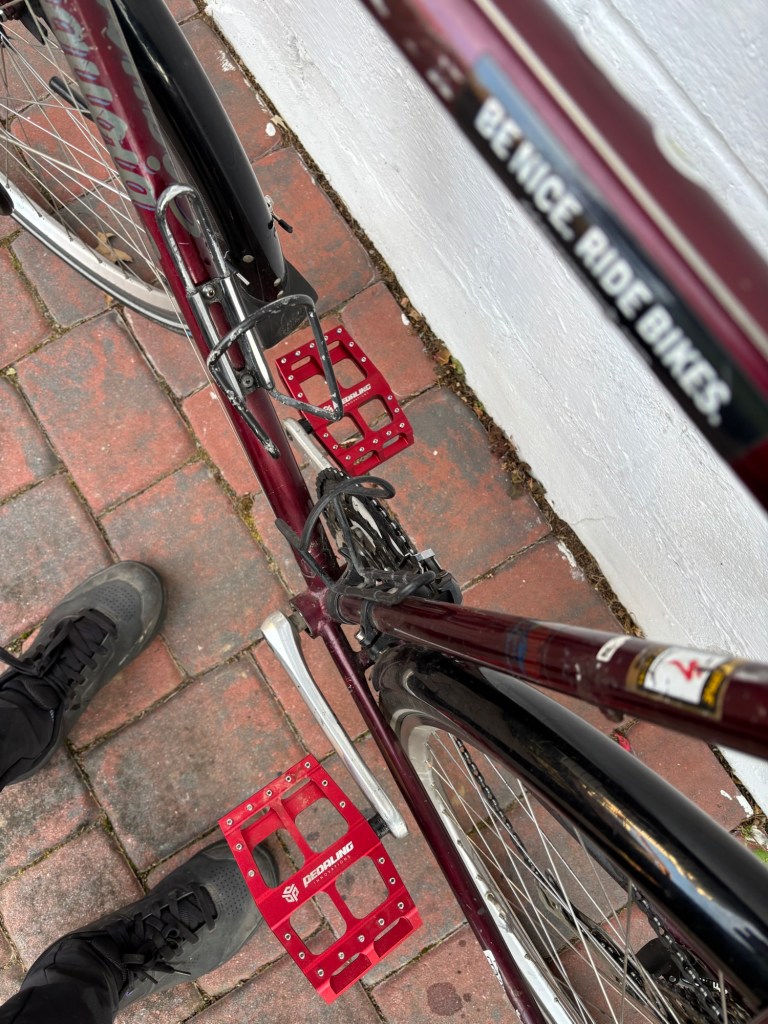
The other pinned pedal I considered was the Catalyst pedal by Pedaling Innovations, a small company based in Fruita, Colorado (which I rode past in 2009). These pedals have a rectangular shape that is longer than their width. Simply put, they are huge. They are intended to be used differently that other pedals. With all the other pedals that I’ve used, the pedal axle is positioned under the forefoot; with Catalysts the axle is further back, beneath the arch. The idea is to engage the big muscles of the butt and thighs while pedaling.

One big advantage to platform pedals is that I don’t have to wrestle my forefoot into the toe clip. This is especially a problem with winter shoes. As temperatures have fallen, I’ve started using some old, ankle-high hiking boots with the Lambdas. These boots have a flat sole and they work like a charm. It does seem to take me a mile or two to orient my feet on the pedals so that they don’t slip off. Usually, they only slide a bit to the outside. It’s not a big deal but I have to think about it for a while before the contact of my foot on the pedal becomes second nature.

The nubs around the outside help a bit with foot slippage. On the pinned version, the pins go through these nubs.

I did move my saddle forward a bit as most on-line commenters suggest. (See below.) This created a slightly cramped cockpit so I lowered my handlebars one millimeter. After that I felt dialed in.

The Catalyst is a whole ‘nother animal. I took them for my first test ride today using my Shimano touring shoes that have a rubbery flat sole. Following the advice of the manufacturer I slid my saddle forward and down just a bit. I rode 33 miles, deliberately climbing one small, steep hill to check out their climbing performance.

What I liked most was how the pins kept my feet firmly on the pedals. And when I climbed, I stood up and rode out of saddle for a bit. The big platform felt like a stair tread. Solid. It felt like I was going faster than usual but that may just be wind or the fact that the Sequoia is inherently faster than the CrossCheck or simply adrenaline.

Today the owner of Pedaling Dynamics sent me an email and advised that it will take a while to adjust to the pedals. I can already tell two things. My butt muscles feel a bit sore, in a good way. The new foot position definitely distributes the stress of pedaling differently than my toe clip set up.

The second thing is that, like with the CrossCheck, I felt a little cramped while riding. I’m think I raised the saddle and slid it forward too much. I hope the weather allows me to do a reasonable amount of riding so I can get the set up dialed in.

In the meantime I’m going to admire the Christmas-y vibe they give my bike.

They almost look like candy. Ho ho ho.

Long story short, I’m going to ride the Catalysts for a couple of weeks and see how I like them. So far, so good.