


The National Park Service is (finally) replacing some old, damaged bridges on the Mount Vernon Trail near my home. The infamous Bridge 12 between Fort Hunt Park and Collingwood Road was replaced last year. The old bridge was dilapidated. The trail dropped down through a nasty curve on either end to reach the bridge. It was a flawed design from the get go, one that the Park Service incorporated into several other sections of the trail presumably to make the trail a fun meander. Fail. The approach to the new Bridge 12 is straighter and, the bridge deck is considerably wider. Like nearly all bridges on the trail it is made entirely (as far as I can see) from wood. This is not the best choice of decking material for shaded areas but it’s what we got.
This month the Park Service began replacing Bridge 23. This bridge, one of the longest on the trail, pases through Dyke Marsh Nature Preserve. It is where I take sunrise pictures on my early morning excursions to DC. The bridge was heavily damaged twenty years ago by epic storm surge from Hurricane Isabel. The Park Service did a few emergency repairs but it was clear that the decking, once level, was now slanted this way and that in several spots. Over the years, the wood decking has been replaced board-by-board, usually by volunteers.
I, and many others, submitted comments on the replacement bridge last spring. My comments came down to (1) don’t use wood for the decking (it becomes very slick when wet or icy) and (2) raise the decking and the adjacent trail by at least a foot to allow for high water events which have increased in frequency in the last ten years (you ain’t seen nothing yet).
Work began in earnest last week. A detour was set up that uses a lane of the George Washington Memorial Parkway. (This section of the Parkway is also scheduled for replacement. Riding the detour one can see why. There are a couple of nasty potholes and sections of the concrete have lifted at the joints.) As soon as the detour was open, contractors started ripping up some of the bridge decking. Then they started bringing in materials.
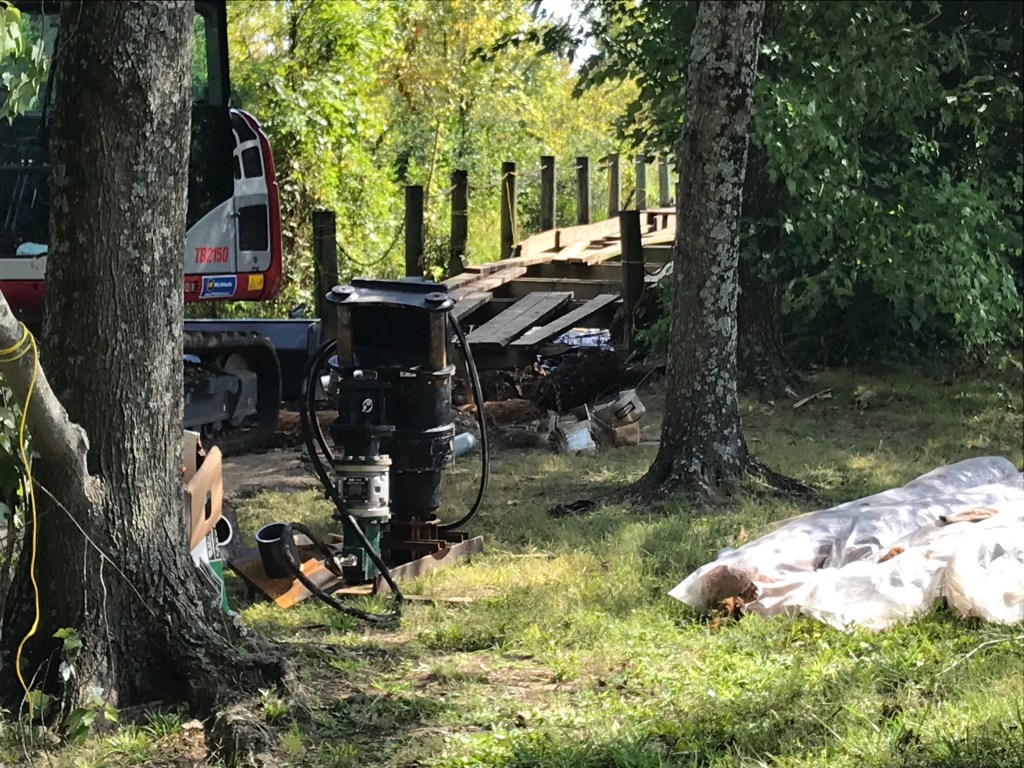
The pictures above show some of what’s going on. On the north side of the bridge, there are some pretty serious looking I-beams as shown in the picture on the left,. They have flat metal panels on one side. It’ll be interesting to see where these pieces will fit in the puzzle. Next to the I-beams and not pictured where some beefy looking dark brown wooden posts with holes drilled in the side.
The middle picture shows how some of the deck boards have been ripped up. This work was started last week then stopped. I suspect the contractor saw something it wasn’t expecting. The gizmo in the center looks like a tamper used on the asphalt section of the detour. The rolls on the right (under the plastic) are used to control drainage during construction.
The picture on the right is taken from the south end of the crossing. There are some wooden boards. Boo. Behind them are some mystery materials under wraps. To me the most interesting part is the metal tubing. Hmm.
I am guessing that some sort of temporary structure is going to be built so that the workers don’t have to stand in the marsh. In any case, I am looking forward to how the pieces fit together.
There is an access point to the trail at the southern end of the span where Tulane Drive intersects the Parkway. Originally, the contractors had blocked access to the trail with the jersey barriers that separate the detour lane from Parkway traffic. Last week the contractor put a gap in the barriers to facilitate access to the trial from the Tulane neighborhood.
 A Few Spokes Shy of a Wheel
Yes! What is it with all this annoying wooden decking that the NPS is so fond of? I’ve ridden on some very nice bicycle/pedestrian bridges that appear to be made of a composite impregnated with cement/concrete. It’s really nice to have a smooth yet grippy surface in the wet.
It’s really a matter of managerial incompetence. They’ve been told innumerable times not to use wood but they don’t listen. I’d love it if the MVT would be turned over to the NVRPA, who operate the W&OD
And wood is cheaper, more familiar, and any scout with a hammer and saw can build with it.
If the NPS had to pay for the damaged bikes and for the medical bills of all the people (me included) that crashed on their crappy wooden bridges they’d think twice about how cheap wood is.
Well I hope it turns out better than the Albany County Rail Trail Bridge replacement (the one you detoured around). They poured concrete and the bridge buckled. No reason was given for weeks. They cleaned up the mess and are going to rent a “temporary” bridge fir $600,000. The other day they said the bridge that buckled had a design flaw. The company that designed it had the exact same thing happen elsewhere a few years back. But they used them anyway.
Whoohooo!! I am excited for your first ride on these new bridges. Persistence paid off.
It’s going to be awhile. Maybe by next June they’ll be done