Natchez Trace Tour – Final Thoughts

It’s been over a week since I competed my van-assisted tour of the Natchez Trace with the Adventure Cycling Association (ACA). I’ve had time to reflect on things. Here are some thoughts.

Tour Administration

I signed up for a tour that began in Nashville, a 10-hour drive from home. Day 1 of the tour was supposed to involve a 9-hour shuttle ride from Nashville to Natchez. Apparently previous participants found this unappealing. (I can’t argue with that.) A week or so after I committed and paid for the tour, I was notified that the tour would begin in Jackson, Mississippi, a 15-hour drive away. It would still involve a shuttle from the end in Nashville back to Jackson. I was notified that if I wanted to return to Jackson at the end of the ride, I would have to cough up an additional $75 for a seat on the shuttle. Finally, the itinerary was changed to include a 90-mile day. These changes gave me the impression that the entire operation was amateurish.

Participants were also advised that it would be wise to bring a light-weight road bike instead of a heavy touring bike. The Mule, which I long ago altered with easier gearing for touring, has carried me on 8 loaded tours over 10,000 miles. The Mule was not amused.

Fortunately, once I was on-site, the mishigas stopped and the tour itself was well-run.

After the tour, I received an email with a link to a feedback survey from the tour organizers at Adventure Cycling. Like most people, I have filled out dozens of on-line surveys without incident. This survey was a Microsoft product that failed to accept my login information. Try as I might, I couldn’t crack the secret of launching the survey. I have never encountered survey software this lame before. I ended up sending an email with some feedback to Adventure Cycling instead.

Operational Aspects

The tour co-leaders were Jeff and Beth Ann, both of whom are very experienced. The experience showed. There was a system to every aspect of the tour. The whole thing went off like clockwork with only a couple of glitches that were easily resolved.

Shopping for and cooking dinner, breakfast, and lunch was the responsibility of the riders, organized into groups of two or three people each day. It was obvious that the idea of rushing through a long ride to shop for food so that the rest of the riders could eat before dark was unappealing. We all knew this cooking and shopping arrangement was part of the tour but the reality of it just didn’t sink in until the second 70+ mile day. Remarkably, each group had a creative chef and support crew. Vegetarian options were provided which is quite a trick when cooking outdoors for 15 people. Also, Jeff taught us how to make coffee using a French press. Suffice it to say, bicycle tourists drink the stuff by the gallon and it was very good.

On the second day we were confronted with a situation near Jackson. Traffic is quite heavy in this area. Trail users are normally required to use a side path but the path was under construction. The tour leaders offered a shuttle ride past the problem area and we all accepted the lift. Safety first.

The 90-mile day began with a long, steep-ish climb from our lakeside campground back to the Trace. Some of the riders were already tired from three long days. It became clear that most of the riders wanted nothing to do with the either the distance or the climb and requested a “push”, a shuttle ride 20 or so miles into the route. The tour leaders met this request without drama. (It’s a serious pain to load and unload the bikes onto the roof of the van so the leaders’ cooperation was not without significant effort.) I decided to ride the whole 90 miles. Jeff had told us of a stone wall (a man’s tribute to a relative who walked the Trail of Tears) that was a must see along the route. There was no wayfaring information on the Trace so we would have missed this otherwise. It was beyond cool. Unfortunately, with 90 miles to cover in a day, I felt I couldn’t stay at the wall more than a few minutes. (As it was I was the last person to finish for the day.)

Tour Lowlights

Sleep: For some reason I struggle to sleep on bike tours. Camping, hotels, Warmshowers…it doesn’t matter. I don’t think I had more than 4 continuous hours of sleep on any night during the tour. When I arrived home, I slept like a log for 3 straight nights.

My Back: Whenever I was off the bike, I had back pain, caused by my lumbar spinal stenosis. Lugging things to and from the trailer, hefting my bike up to Jeff on the roof of the van, not consistently doing my therapy exercises, poor sleep, and driving 15 hours to the start all contributed to an incessant dull ache in my lower back whenever I was on my feet. (I had no such pain while riding, however.) Once home, I switched to riding Big Nellie, my Tour Easy recumbent, for a week and got back on my therapy routine. It feels much better now but I am still thinking of getting a referral to a surgeon.

The Fixed Itinerary: I didn’t think about this when I signed up but normally I draft an itinerary for all my tours. Each day’s ending point is determined by the availability of a place to sleep. If I am feeling spunky, I ride farther (I’ve done more than 100 miles in a day several times). If I’m dragging, I take a short day or an off day. On an organized tour, you pretty much are locked into an itinerary. Not much of a lowlight, but I wanted to mention it anyway.

Waiting: It takes quite a long time to cook and clean up dinner for 15. It’s nice to have company but the waiting can get irritating. It’s worth noting that the leaders’ organization helped keep this under control.

Truck Sewer: The drive to and from Jackson was especially stressful on I-40 in Tennessee. The truck traffic was incredibly heavy. From time to time the trucks would clog both lanes and traffic would go from 70 to 0 without warning. Ugh.

Tour Highlights

Weather: Days began in the 40s with temperatures rising above 55 degrees within an hour or so. It rained for a grand total of 15 minutes. Once. Humidity was low until the last day. Darn near perfect

Bugs: Except for a spider bite on the first or second day, I saw virtually no evidence of bugs. This sucks for the frogs and birds but it was pretty amazing for bike riders and campers.

The Road: The Natchez Trace does not allow commercial truck traffic. The pavement reflects this. It was smooth nearly the entire way. There were occasional expansion joints but these were the exception. There was very little wild life. Road kill was minimal (but the armadillo was pretty cool).

Windsor Ruins: Windsor Ruins is about ten miles off the Trace. The road surface was rougher and the terrain was hillier. It was worth the extra effort.

Wichapi Stone Wall: This thing was amazing. I could have spent well over an hour there. It’s only a few hundred yards off the Trace. A must see.

Cypress Swamp: We rode through a cypress swamp on the third day. There’s a boardwalk but you can also see the swamp from the road. Spooky. (No, we didn’t see any gators.)

Scenery: Leaving Jackson on Day 3 we rode by a 50-square-mile acre reservoir. Other than this and the cypress swamp, the Trace passes through woods and small farm fields for the entire route. With mostly very light traffic (except near Jackson and Tupelo), no turns, no stop signs, and no traffic lights, the Trace is hard to beat for losing yourself. (If you want to you can park your bike and take a walk along the Old Trace footpath. Just the thing for the tired cyclist.)

Showers: Getting into the vibe of a long bicycle tour typically includes a few days in a row without showers at night. Not that I find this appealing. We had showers on all but one night. Well played ACA!

Leadership on the Ground: Jeff and Beth Ann were both very experienced tour leaders but they had never led a tour together . They complemented each other like Astaire and Rogers. Jeff is the chill-est human on the planet. Beth Ann is a bit more frenetic. They were organized, knowledgeable, helpful, and utterly professional.

The Riders: I’m an introvert and find that self-supported solo touring is my preferred way to ride. It’s remarkable that I can only think of one unpleasant bike tourist I have dealt with in all my time on the road. Even so, putting 13 people together on a tour is pushing your luck. Fortunately, our Natchez Trace group of 13 riders was remarkably harmonious. And old. Eight of the 13 riders were between the ages of 69 and 74. And fit. Dang, some of these old folks can move! And pretty good at cooking. And intellectually diverse: we had, among other things: a doctor, lawyer, bank examiner, economist, professor of environmental science, farmer, and eagle expert. We heard funny stories about life on a submarine (don’t press the red button) and the full contact ballroom dancing.

Food: One of my biggest problems on a bike tour is eating well. Peanut butter on tortillas is my go to. I have been known to inhale a Pop Tart or four for breakfast. One big advantage of this tour is that the food was pretty darn good.

Three More States: I added 3 states (Mississippi, Alabama, and Tennessee) to my list of states biked in. I’m now up to 41. If I had thought about it, I easily could have driven to Louisiana and Arkansas. Oh well.

Temporary Southpaw No More

Tuesday morning was my first post-op appointment with my hand surgeon. As expected my (3) stitches were removed. They were replaced with three steri-strips, which will hold the incision together for the next week when they should fall off.

I disclosed all my symptoms to the surgeon and he said “That’s normal” over and over again. I have various pains in my hand and even my elbow but the doctor said that unless they persist they are not a big deal.

I go back to the doctor in mid-March for another status check. In the meantime, I can use my hand “as tolerated”. It was time to put the hand through its paces.

Later in the day we had our second significant snowfall of the season. Mrs. Rootchopper and I went outside after three hours of snowfall and had at it. There was about two inches of snow on the ground and more was coming down fast.

I started by using a tool to clear the snow off our cars. My right hand didn’t much like this but once I warmed up, adapted my grip, and gave most of the work to my left hand, I had no problem. Next I picked up a snow shovel and cleared the sidewalk, driveway, and other areas. No problem. My hand was a bit sore but functioned well. More snow fell overnight so I went back out before breakfast and had at it again. If anything, my hand tolerated round two of shoveling better than round one.

Second snowfall of the winter

Yesterday, I took The Tank out for a ride. This was my first time on a conventional bicycle since the surgery. I made it ten miles without discomfort. I soldiered on, moving my hand position and unweighting my right hand, for another 20 miles. At the end of the ride, my neck hurt much more than my hand. My body is a wonderland of pain. Before riding today, I rotated the handlebars a smidge toward me. That did the trick. My neck tolerated the ride just fine. My hand held up without discomfort for 18 miles. I continued on as before, for another 12.

My bigger concern during today’s ride was the scary drivers I encountered. One driver turned sharply across my line of travel. I made eye contact and yelled at him. I could see that his car showed signs of multiple fender benders.

Earlier I passed Porto Vecchio, a condominium on the Mount Vernon Trail. Today, a car blew through the red light across the trail to make a left turn across traffic heading in both directions. How the seemingly oblivious driver avoided a crash is beyond me. Not to be outdone, left-turn driver was immediately followed by a right-turn driver who blew through the red light, just as a driver who hit me at this very spot in 2019. I third car pulled up aggressively as if to blow the light. I yelled at the driver to stop as I about to cross in front of the car. WTF.

After the snow shoveling and bike riding, I iced my hand for a half hour. So far, my hand seems to be bouncing back from these efforts without problems.

Sooo,

Today, I signed up for the Adventure Cycling Association’s van-supported Natchez Trace bike tour. It’s 456 miles in seven days. I have been putting off this decision for days, thinking that I might not be in shape for some seriously long days in the saddle (the longest day is 82 miles). Thanks to the van, however, I’ll be touring, for the first time, without carrying 40 pounds of gear; I only have to carry rain gear, some basic bike tools that I carry all the time, and snacks.

My next objective is to lose some weight in the next seven weeks.

No gut. No glory.

Top Ten for 2023

Once again it’s time to take stock in stuff that happened over the last 12 months. Here we go in no particular order.

  1. The Boy Comes Home – After four years, our son came home from Thailand for a visit. We rode bikes and went to baseball games and hung out. During his travels, he also managed to see West Virginia, Indiana, Chicago, Montana, New York City, and Romania. Go figure. It seems impossible that he is 32 and living on the other side of the world. If you ever want to learn to scuba dive in Thailand, he’s your man.
  2. Cold, Rain, Hills, Smoke, Mud – Bike Tour 2023 – I’ve never ridden in Maine but I’ve been to Oklahoma. Okay, I’ve never ridden in Oklahoma either, but the line worked for Hoyt Axton. After the southern half of the Adventure Cycling Atlantic Coast Route by riding from DC to Key West in 2017, I decided to finish the route by riding from DC to Bar Harbor, Maine. Rather than re-trace my steps down the coast, I made a big loop from DC to Bar Harbor to Lake Ontario to Niagara Falls to Erie, PA to Pittsburgh to DC. The first month was cold and wet and brutally hilly. I managed to avoid the smoke from Canadian wildfires until Erie, PA where I rode in Code Purple air with an N95 mask on. No problem. I rode in a foreign country for the first time, riding along the Niagara River in stormy Ontario. The final push on the C&O, which was supposed to be the easy part, featured slogging through miles and miles of thick mud and a brutal hike over a mountain to bypass the closed Paw Paw tunnel.
  3. Bike Events – I rode five bike events this year. The Washington Area Bicyclists Association changed the name of its May ride from the Spring Fling to the Bike How You Like Ride. I rode the Spring Fling a few years ago and it was brutal. I swore I wouldn’t do it again. Fool that I am, I learned the morning of the ride that the BHYLR was the same course. Oof. Somehow it was easier this time. In September, I rode the 50 States Ride for the 15th time with a splendid posse. The route took us all over DC clockwise for the first time but we still had to contend with a brutal climb through the Palisades to Cathedral Heights. In October, I rode the Great Pumpkin Ride in the Virginia Piedmont for the umpteenth time. This time I brought my own snacks and rode it solo nonstop. The weather was perfect and avoiding long lines at the pit stops cut my time by nearly two hours. In November, I rode the Cider Ride with most of my 50 States posse. On this year’s ride one member of the posse rode all 60 miles on little more than water, a slice of apple pie, and a stalk of celery. Incroyable! Later that month I rode the Bike for Your Life event. The point of the ride was to raise awareness of the problem of traffic violence in our area. We passed four ghost bikes (indicating where a driver killed a cyclist) before ending at the ghost bike of a five-year old girl.
  4. Big Nellie Hits 50,000 Miles – It’s been over 20 years but persistence paid off as Big Nellie, my Tour Easy recumbent, finally broke the 50,000 mile barrier. (This does not count the hundreds of miles ridden on the bike indoors during the winter months.)
  5. Little Nellie and The Tank Re-born – I had all but stopped riding Little Nellie, my Bike Friday New World Tourist, because of the intense lower back pain I experienced after even short rides. I decided to swap out the drop handlebars for more upright H bars. It made a world of difference and I ended up riding the bike over 2,000 miles this year. In late December I was ready to get rid of The Tank, my Surly CrossCheck. Riding it gave me weeks of intense nerve pain in my back, arms, shoulders, and neck. Then I made seemingly minor adjustments to the seat and handlebar height. The bike now goes considerably faster with less effort and my nerve problems have all but disappeared. With a few twists of an allen key and some headset spacers, I saved a bike and avoided the medical merry-go-round for the winter.
  6. 50th High School Reunion – I attended my 50th high school reunion. My high school classmates are so old! During the trip, I visited with family and did a bike ride with my brother Jim on the new rail trail that runs from the Hudson River to the village of Voorheesville west of Albany. I also managed to check out the Walkway over the Hudson in Poughkeepsie, the home of Franklin Roosevelt in Hyde Park, the graves of Franklin and Eleanor Roosevelt in Hyde Park and of Chester A. Arthur near Albany, and my parents’ and my brother Mike’s graves. I also found the weathered tombstone of my great grandfather Sylvester.
  7. King Lear at Shakespeare Theater – My wife, daughter, and I saw a mind blowing performance of Patrick Page as King Lear, He stole the show when we saw him as Iago in Othello many years ago but his Lear was next level stuff. From the second he stepped onto the stage we were gobsmacked. It helped that we were in the second row.
  8. The Mule Gets Some TLC – I took The Mule into the bike doctor for a physical and found out that, among many other things, the rims had multiple cracks in them. The new rims were right as rain after my summer bike tour. Later in the year, after years of frustration over rear brake rubbing issues, I finally forked over the big bucks and had an expensive brake installed. It works great.
  9. Crowded House – My favorite band from the Antipodes was supposed to play DC in September 2022 but the drummer injured his back. I can relate. The concert was rescheduled for March and was worth the wait. Liam Finn, a band member, opened the night with a frenetic solo performance. The main event was terrific, marred only by two drunken idiots who sat in the row behind us and talked loudly through most of the songs.
  10. Museum of African American History – I finally got to see this amazing new Smithsonian museum. We spent hours in the place and only saw half the exhibits, mostly about slavery, Jim Crow, and civil rights. I need to go back to see the rest, most of which is likely to be more upbeat.
  11. And one more for Nigel Tufnel: In January I became a lifetime member of the Adventure Cycling Association. Without ACA maps and advice, I’d never have done so much touring or had so much fun. I should have done this years ago (and saved 20 years worth of annual membership fees) but I didn’t think I’d ever do this much touring.

Thinking Ahead – Tour 2024 and Beyond

So here’s the thing. It was raining cats and dogs outside on dreary November day. I decided to give my bikes the day off and my thoughts turned to the future.

I have three events that constrain my touring activities for next year. In April, I’ll be in Indiana for the total solar eclipse. In May, I’ll be in Hartford for my daughter’s law school graduation. In early October I’ll be on the north shore of Massachusetts for a wedding. Of course, I want to be back in DC for the fall riding events so September and November are out. Barring some additional unknown obligation, that leaves mid-May through the end of August for touring. Perfect. Of course, plenty of other things can come up in the meantime but rainy days in November are perfect for dreams of summer on the roads.

Of course, one thing I still want to accomplish is to ride my bike in all 50 states. Most of the states I am missing are in the south and the middle of the country. Here are two ideas that I’ll be rolling around in my head for a few months.

Hot and Sweaty

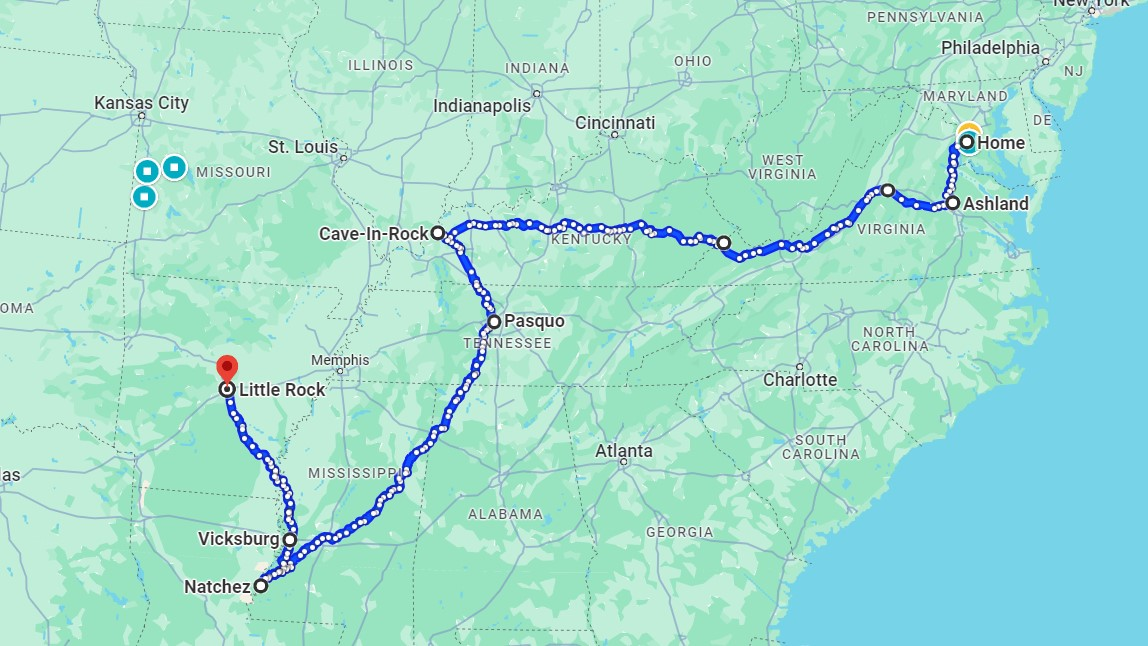
My southern tour idea would pass through Virginia, Kentucky, Tennessee, Alabama, Mississippi, Louisiana, and, maybe, Arkansas. (The states in italics would be new ones in my 50 states quest.) It would rely mostly on three Adventure Cycling touring routes: the Atlantic Coast, Transamerica, and Great Rivers South routes. Here’s how it would go. Riding south from the DC area to Ashland, Virginia, just north of Richmond (Atlantic Coast), I’d bang a right and head west to the Blue Ridge Mountains. Crossing over the ridge I’d drop into the Shenandoah Valley then southwest to the Kentucky border at The Breaks Interstate Park. I’d cross Kentucky until just north of Cave in Rock, Illinois (TransAmerica). From there I’d head south to the Nashville area where I’d pick up the Natchez Trace Parkway. The Natchez Trace goes southeast through Tennessee to the very northwest corner of Alabama then turns southwest across Mississippi. After the Trace, the Adventure Cycling route continues south, across the Mississippi River to Baton Rouge, Louisiana (Great Rivers South). Just beyond the end of the Trace I’d cross the Mississippi River into Louisiana through Baton Rouge to New Orleans and fly home. This makes for about a 1,700 mile tour.

This tour has some interesting aspects. First, it is logistically pretty simple. I only have to figure out how to get my bike and me home from the finish. Second, it uses the TransAmerica route for about half the distance. The TransAmerica has been in existence since 1976 so there are loads of places to stay. It uses the Natchez Trace which does not allow truck traffic and has numerous campsites and other places to stay. The Great Rivers South route goes near a few interesting places like Muscle Shoals, Alabama (famous for two music studios) and Tupelo, Mississippi (Elvis Presley’s birthplace). And if I get really ambitious there are scads of Civil War sites. The big downside to this route is that it can be oppressively hot and humid in the deep south. At least this means I can bring lighter gear. Two other unfun considerations are the dogs and steep hills of eastern Kentucky.

An alternative would allow me to pick off Arkansas. The bridge across the Mississippi at Natchez looks like a death trap (no shoulders, beaucoup trucks, rednecks in beat up pick up trucks, Easy Rider nightmares) so I would have to turn north somewhere along the southern part of the trace. I could ride 90 miles from Natchez to Vicksburg and cross the river there on an old two-lane bridge that is right next to an interstate bridge and likely to be lightly used. Once across I’d head north into Arkansas ending at Little Rock. The area along the river in Mississippi is a series of short steep climbs but oddly not too hilly in Arkansas. This 350-mile side trip is an awful lot of riding to pick off one state though.

The DC to Little Rock Tour. (Note New Orleans is just off the bottom of the map directly below Natchez.

Fly Over Loop

Should my spouse decide to visit her parents in northern Indiana, I could start a tour from there just as I did in 2019. This route would run through Indiana, Illinois, Kansas, Iowa, South Dakota, Wyoming, Nebraska, Colorado, Texas, Oklahoma, and Arkansas. I’d begin riding due south to Indianapolis where I’d pick up Adventure Cycling’s Eastern Express route. This route would take me west across Indiana and Illinois to Saint Charles, Missouri. There I’d pick up the Adventure Cycling’s Lewis and Clark route and follow the Katy Trail and the Missouri River west. I’d continue northeast of Kansas City into Kansas, Iowa, and Nebraska until turning west at Sioux Falls, South Dakota. I’d then follow the Adventure Cycling Association’s Pikes, Peaks, and Prairies route across the Badlands to Mount Rushmore. I’d head north along the Michelson Trail through the Black Hills to Deadwood. Next I’d turn west to check out Devils Tower in Wyoming before heading south across the prairie through Nebraska and Colorado to Amarillo, Texas. At Amarillo I’d bang a left and head east across Oklahoma into northwest Arkansas where I could finish near Fayetteville.

I suppose I could simplify this tour by riding straight across Iowa. That would take some additional planning though. The highlights of this tour would be the Badlands, Devils Tower, and the Michelson Trail, which has a stellar reputation among tourists. The lowlights would be heat and wind. Most of the Great Plains can get brutally hot in mid-summer. The long ride south from Wyoming to Texas likely would be into a strong headwind. Also, there are long stretches on this route without any services including water. BYOB.

The whole loop would be about 3,000 miles, the same distance as my Indiana to San Francisco tour in 2019.

It would make a heck of a lot more sense to start the tour in Sioux Falls but that would involve an additional logistical hassle. Also, I’d miss out on so much corn and soy and livestock.

Flyover Tour.

Beyond 2024 and 2025

Aside from Alaska, which would involve some sort of special one-off trip, I’d still need to pick off the southwest. There are two options.

Option one would follow Route 66 from Santa Monica, California through northern Arizona and New Mexico (with side trips to the Grand Canyon and Sedona) ending who knows where. I could even go all the way home which would be about 3,500 miles. If I still needed Arkansas, I would ride from Tulsa to Fayetteville before rejoining Route 66 in Joplin, Missouri.

Another option would be to cross the country from San Diego to New Orleans. This could be combined with the first tour above to pick off seven states in one go. That would be somewhere over 3,300 miles. Also, I’d probably stop in Phoenix to rent a car to go see the Grand Canyon and Sedona.

Any tour involving the desert Southwest would start in early April to avoid the impossible heat of the desert southwest in May and June. I’d finish in June.

The biggest impediment to conquering the 50 States challenge is age. I lost two good touring years to the pandemic which pushes a completion out to my early 70s. As old as that sounds I recall meeting two 70-something riders in my bike travels. I met one man near Fort Scott, Kansas. He was riding north to Sioux Falls, South Dakota before turning left for somewhere in California. I encountered the other elderly rider near the Oregon/Idaho border. “When I was young this was fun; now that I’m old, it’s work.”

Then there’s the 80-year-old man I met in Sheridan Lake, Colorado in 2022. He was riding a tadpole (two wheels in front) trike and pulling a trailer. His daily mileage was low but he started in Denver and was headed somewhere east.

Tour Prepping

Between doing the taxes, testing out the new, improved Little Nellie, and shopping for gear, I have begun preparations for my 2023 bike tour. The plan is to ride from home in Mt. Vernon, Virginia to Bar Harbor, Maine. From there, I ride home. Somehow. Using mostly the Adventure Cycling Atlantic Coast Route, I constructed a preliminary itinerary, mostly guided by the availability of campgrounds and motels. The ACA maps also contain info on where to buy food and the location of interesting places along the way.

New Gear

One of keys to a successful tour is getting a good night’s sleep. I have had mixed success in this regard. For last year’s tour I brought a Sea to Summit pillow. It’s much better than sleeping on a pannier filled with clothes. And it packs down to the size of a can of corned beef hash.

I have been using a lightweight REI Sleep Sack for most of my tours. This is a sleeping bag with very little insulation and an open toe box. It was great for sleeping on warm nights during my previous tours but it was woefully inadequate on the cold nights in the mountains out West last summer. I fear Maine may get a bit cool at night so it seemed like a good time to upgrade.

Last week I bought a Nemo Forte bag rated to 30 degrees. It packs down to about twice the size of the Sleep Sack but fits snuggly in one of my rear panniers. I gave it a try in my family room. Dang. Soo comfy!

This week I bought a Themarest NeoAir Xlite sleeping pad. It’s what Mark and Corey, two very sound sleepers, used last summer during our tour through the mountainous West. When I got it home I used the included air sack to inflate it. The air sack is the new thing in camp gear inflation. It’s a super lightweight bag with a valve at one end. The valve attaches to the intake valve on the sleeping pad. You roll the top of the bag down, trapping air inside. As you continue to roll the top down the air squeezes into the pad. Repeat as necessary. I had to do 13 iterations before the pad was filled. PIA. Mark and Corey used a small battery powered pump. You attach the pump to the valve and go about your business setting up camp. The pad inflates in a matter of minutes. No muss. No fuss. Long story short I’m going to get me a pump soon.

I tried the bag and pad out on my family room floor. It’s about as comfortable as sleeping in bed. The padded rug underneath helped but I’m satisfied that my sleep problems will be a thing of the past. I’ll test everything out in the backyard in April just to be sure but I have a very good feeling about this.

I also bought an REI brand walking cane. It collapses down to a couple of feet in length. I should be able to strap it to my rear rack or put it inside my rack top dry bag. This should come in handy when I get to Valley Forge and other places worth exploring off the bike. Take that spinal stenosis.

In addition to the pump, I’ll probably buy a new dry bag. My old one still holds plenty of stuff but it has a duct tape patch on one end which is not ideal for keeping things dry.

The Route

Using the Adventure Cycling maps, I did some cogitating. As I said, places to sleep are a key determinant of the length of each day’s ride. The maps tell me where to find campgrounds and motels but not Warmshowers hosts which are abundant. I factor in the Warmshowers options as I ride.

One of the disadvantages in travelling alone is that hotels and motels will be more expensive since I won’t be able to split the cost with other riders. One of the advantages of solo touring is the fact that Warmshowers hosts tend not to want to deal with more than one or two people per night. Thsi was a source of frustration for Corey. Mark, and me last summer. I should have many more Warmshowers options as a solo rider

The tour starts May 23, two days after a very busy week. I am planning on attending my 50th high school reunion in Albany, New York. I would have ridden to it but I will also be attending a Crowded House concert in DC a couple of days later. (The concert was rescheduled from September 2022 after the drummer hurt his back.) The route will begin at home and take me through 11 states (Virginia, Maryland, Pennsylvania, New Jersey, New York, Connecticut, Massachusetts, New Hampshire, Maine, and Vermont) and the District of Columbia, This will add two states, New Hampshire and Maines, to my 50 states quest,

Day one will likely be off route to take advantage of Mark’s offer to stay at his place in Linthicum, Maryland south of Baltimore. Riding the ACA route then cutting over to Mark’s place would make for an 80 mile first day. Using a more direct route, one that I used on my first tour in 1999 tour as well as on two other event rides to Baltimore, I’ll be able to shave 25 miles off that distance.

After Mark’s place, I’ll rejoin the ACA route, bypasssing Baltimore to the west and heading up a rail trail to York, Pennsylvania. At York, I hang a right and head across the Susquehanna River to Lancaster County, Amish country. After Lancaster comes Valley Forge which I have never been to.

The route continues skirting Philadelphia to the northwest. North of Easton I cross the Delaware River into New Jersey and head up the Delaware Water Gap. (I understand a detour is in place because of a landslide in the gap. I expect I’ll be doing some climbing.) I’ll ride up the Delaware to Port Jervis, New York. Travelling into New York, I’ll follow a rail trail along the eastern side of the Catskills until I cross the Hudson River on the Walkway over the Hudson Park, a repurposed raillroad trestle at Poughkeepsie. Here I may divert to check out Hyde Park just to the north of Poughkeepsie. The route continues into Connecticut and across the Berkshires. (Knees don’t fail me now!)

At Windsor Locks, after ten days of riding I’ll leave the the route and head south to West Hartford where I will take a rest day at my daughter’s place. Hopefully there will be a minor league baseball game that night.

Back on the road I’ll go back to Windsor Locks and turn right, going across the northern edge of Connecticut to the upper Northwest corner of Rhode Island.

(One possible change to my journey would involve riding off route to Providence where I went to grad school. After that I’d head east to Cape Cod and out to Provincetown. Then take a ferry across Massachusetts Bay to Boston where I went to college. The downside to all this is getting back on the ACA route which bypasses Boston about 30 miles west and north of the city.)

From the corner of Rhode Island the route heads northeast to Westborough, Massachusetts between Worcester and Framingham. Continuing northeast the route enters New Hampshire north of Methuen, Mass. After a night in East Derry, I will head to the coast and enter Maine near York. After that, I ride 200 miles up the coast to Bar Harbor arriving around June 10.

I’ll spend a day exploring Acadia National Park and Mount Desert Island before heading back down the coast following the Adventure Cycling Northern Tier Route. This route coincides with the Atlantic Coast route until Brunswick, Maine before leaving the coast and crossing the Green and White Mountains in New Hampshire and Vermont, respectively, more or less in a straight line.

At Ticonderoga, I’ll re-enter New York State and follow Lake George and the Hudson River down to Albany where I grew up and have family. I’ll take another rest day there.

The current plan is to ride down the Hudson to Poughkeepsie where I will rejoin the Atlantic Coast Route for the ride back home.

I expect I’ll make it home by the first week in July with 2,200 miles of riding under my belt. This will get me back in plenty of time to partake in family events, most importantly, a visit from my son who I haven’t seen since the pandemic hit.

If my son’s itinerary results in him arriving in August, I may head west from Ticonderoga on the Northern Tier instead. Where I would turn south is anybody’s guess. At most this could add 600 or 700 miles to the trip. (In general, the longest route would go from Ticonderoga to Erie, Pennsylvania where I would turn south to Pittsburgh. From Pittsburgh to home is 350 miles of mostly off-road riding.)

Stay tuned.

Lifer

I’ve been wanting to do long distance bike tours for as long as I can remember. The idea really took hold of my imagination when I met a young woman named Anne back when I was in grad school. Anne had ridden across the country on the TransAmerica Bicycle Trail as part of Bikecentennial. Bikecentennial was an event involving several small groups of riders going east and west who used the TransAm crossing as a way to celebrate the U. S. Bicentennial. Anne told me all kinds of tales of her trip. It was profoundly life altering for her.

It took me nearly forty years but I finally made the crossing myself. It was every bit as life altering for me as it was for Anne. Frankly, I don’t know how she and the many others who rode Bikecentennial did the ride with the equipment back then, The thought of riding a loaded-down ten-speed bike over all those mountain passes out west then up and down the Ozarks and Appalachian Mountains in the east blows me away. The bike I rode had 24 gears in a drivetrain that had been modified with lower, easier to spin chainrings. The highest mountain pass I climbed was Sherman Pass in Washington State. At 5,574 feet it was about 10,000 feet less than Hoosier Pass in Colorado on the TransAm.

Sometime around 1990, I became a member of Bikecentennial, the organization that developed the TransAm Trail and the 1976 event. I figured for a few dollars a year I could dream about following in Anne’s tracks while I rode my bike to and from work here in DC.

Bikecentennial the organization became the Adventure Cycling Association (ACA) and developed many more routes across the US (and a bit of western Canada). After a few self-designed bike tours in 2000, 2003, 2004 and 2005, I used Adventure Cycling route maps to ride solo around the top of Lake Michigan in 2016. The next year I used the ACA Atlantic Coast Route to ride to Key West and the ACA Florida Connector Route to cross Florida from Fort Myers to Fort Lauderdale. In 2018 I rode solo from my home near DC to Portland Oregon using maps from four different Adventure Cycling routes. I used three different ACA routes to go from Northern Indiana to San Francisco in 2019. Last year I used two of the ACA routes to go from Saint Louis to Portland, covering the western two-thirds of the TransAmerica Trail in the process.

Last year I noticed that my friend Jeff had become a lifetime member of Adventure Cycling. To my knowledge he’s never done a tour. He just thinks it’s a cool organization worthy of support. A few years ago a couple of BikeDC expats, Emma and Katie, became Adventure Cycling employees. And last fall, my Friday Coffee Club friend Ricky became an ACA board member.

It seemed like Adventure Cycling was closing in on me.

Had I known I was going to be doing this bike touring thing into my late 60s I could have saved a bundle of cash in annual dues by becoming a lifetime member of Adventure Cycling way back in the 1980s. Instead, I paid my dues annually for 32 years, all the while reading about bike touring in Adventure Cyclist magazine, the best bicycling magazine around. I suppose it’s all proof that imposter syndrome is a powerful force. I could at least take comfort in the fact that I was supporting an organization that was doing great things for bicycling and bicycle tourists.

I doubt I have more than a handful of long distance bike trips left in my tank. It makes not a lick of financial sense to do it (heck, I don’t even itemize anymore), but last month I decided to become a lifetime member of Adventure Cycling. I figure I’ll make back the cost in terms of annual dues savings in about 25 years.

So who wants to go for a ride in 2048?

Bike Tour 2022 – Darby to Missoula

I neglected to mention yesterday’s brief moment of terror. Near the end of the seven-mile descent, the road surface changed. The Missouri Department of Highway Mayhem added a rumble strip that I managed to hit at 28 mph. I hit one strip then another before escaping to the paved shoulder. No problemo. Just some wet pants.

We ate breakfast in the cabin after a good night’s sleep. Then we lit out for Missoula some 62 miles downhill to the north. Or so we thought.

After the first ten miles I struggled. We were riding on US 93, the only main north/south highway in the Bitterroot Valley. Traffic was unpleasant. After 20 miles or so we were shunted onto a bike path that has seen better days. (US bike infrastructure motto: we build them but we don’t maintain them.)

Both Corey and I were nearly hit by stop sign runners eager to get onto the adjacent highway. When my near collision happened, I abandoned the trail for the chip seal shoulder of the four lane 70 mph highway.

The road had rumble strips so I could hear any encroaching vehicle. I also have a mirror. I felt much safer.

We stopped a couple of times for gas station convenience food, but my body wanted a break. In Lolo we stopped at Dairy Queen. They have a $7 meal deal that was just the right amount of food (with a small ice cream sundae).

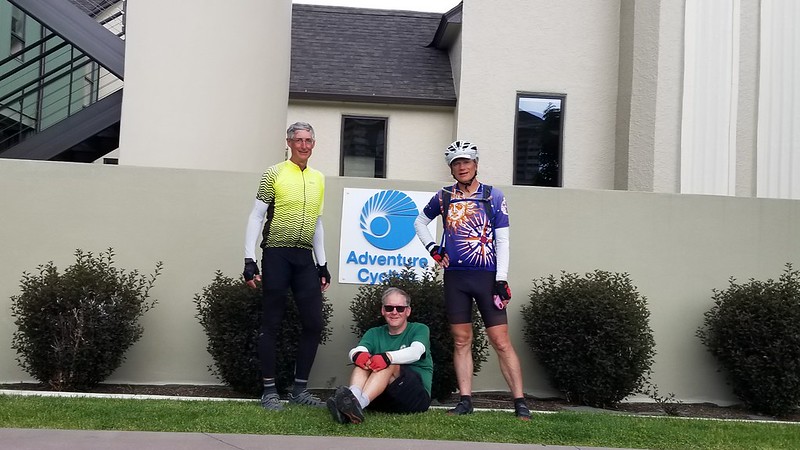
After that the trail into Missoula improved immensely. Once we were in town we rode trails five miles to the headquarters of the Adventure Cycling Association, of which we are all members. The ACA made the maps we are following. I took the lead and somehow brought us to the ACA doorstep without a missed turn.

After some photos we headed a half mile west to a hotel where I stayed in 2018. Our room is a second story walk up but it was recently renovated. It’s my turn to sleep on the floor.

Tomorrow we are taking a day off. We’ve been hitting the hills and the miles hard lately. We need fresh legs for the ride over Lolo Pass on Monday.

Miles today: 70. Tour miles: 2,335.5 (previous day’s miles were messed up)

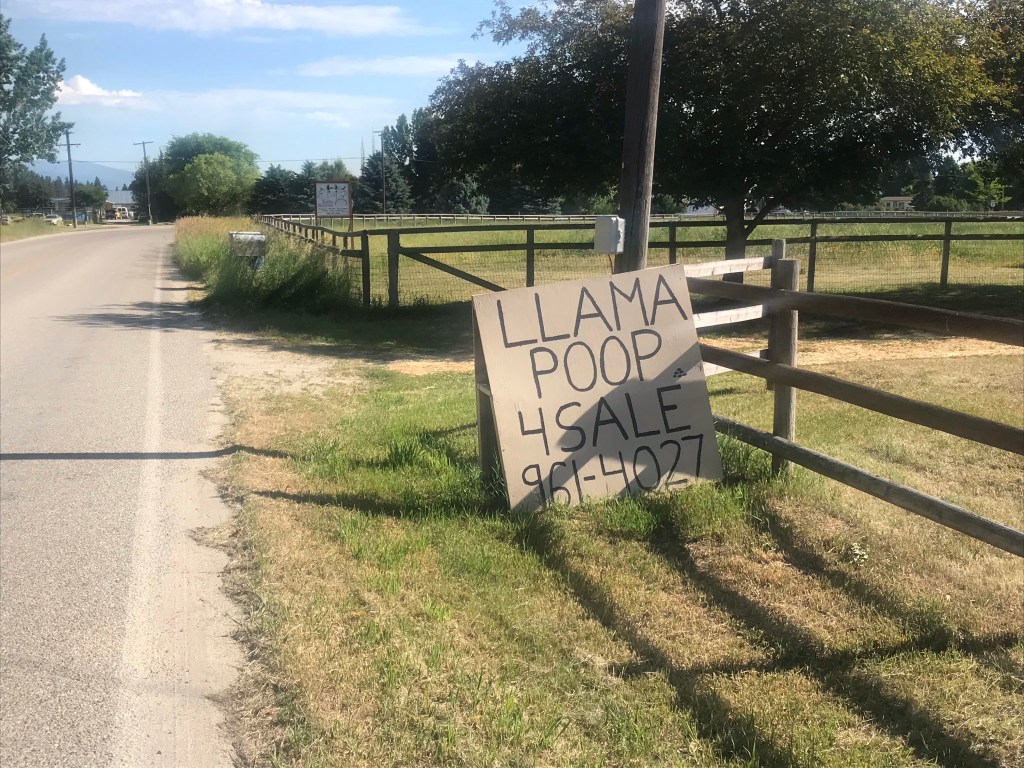
For most of today I felt like llama poop
Mural along the Bitterroot Trail.
A storm was bearing down on us

The End and the Beginning

I’ve lived in the DC area for more than half my life. I’ve been to most of the touristy spots multiple times. Like many people, when our kids were little we took them to the Williamsburg area where there is much to see and do. On the historical side, we visited Colonial Williamsburg and Jamestown, but, for some reason we never got around to Yorktown, where the British army surrendered to end the Revolutionary War on October 19, 1781.

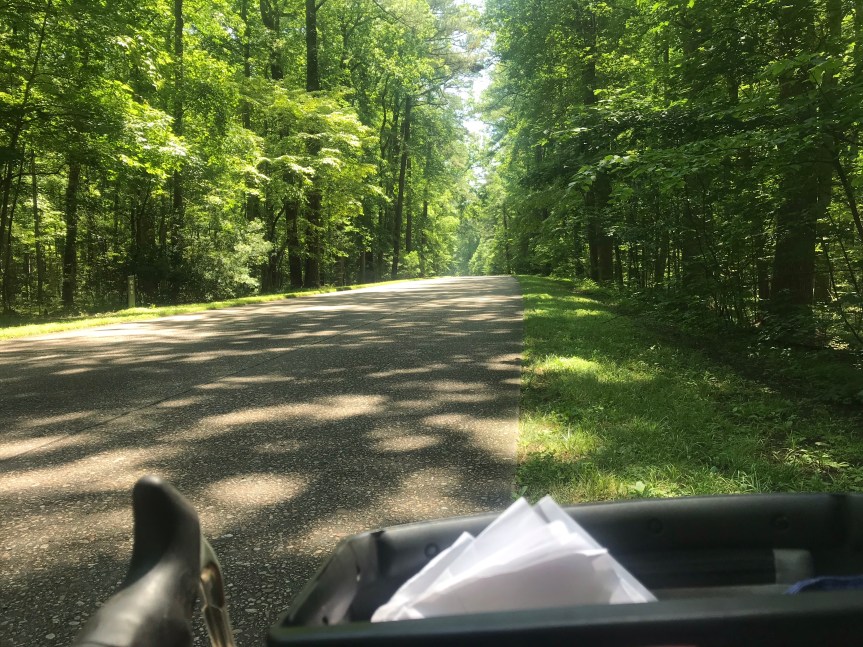
On Tuesday, I remedied that omission on two wheels. Starting at the Williamsburg visitor center I rode the Colonial Parkway 13 miles to Yorktown. The roadway surface, composed of aggregate (small stones in concrete), is a bit rough. It is oddly three lanes wide with no lane markings. Distance is measured not with mileposts but with kilometer posts. I can’t recall seeing this anywhere else in the U. S. It was hot and humid but the ample shade kept me comfortable until the parkway reached the banks of the York River.

Colonial Parkway

The river is wide, perhaps a half-mile or more. The parkway, now unshaded, turns to the southeast following the river and passing through marshy areas and by narrow beaches. After a gentle upslope, the parkway ends at the entrance to the Yorktown Battlefield. The visitors’ center was closed, of course. A few people wandered around zombie-like listening to a virtual tour on their phones. To tour the battlefield takes three hours by car. Unless you’re a serious war wonk, you can cut to the chase and head to the Victory Monument.

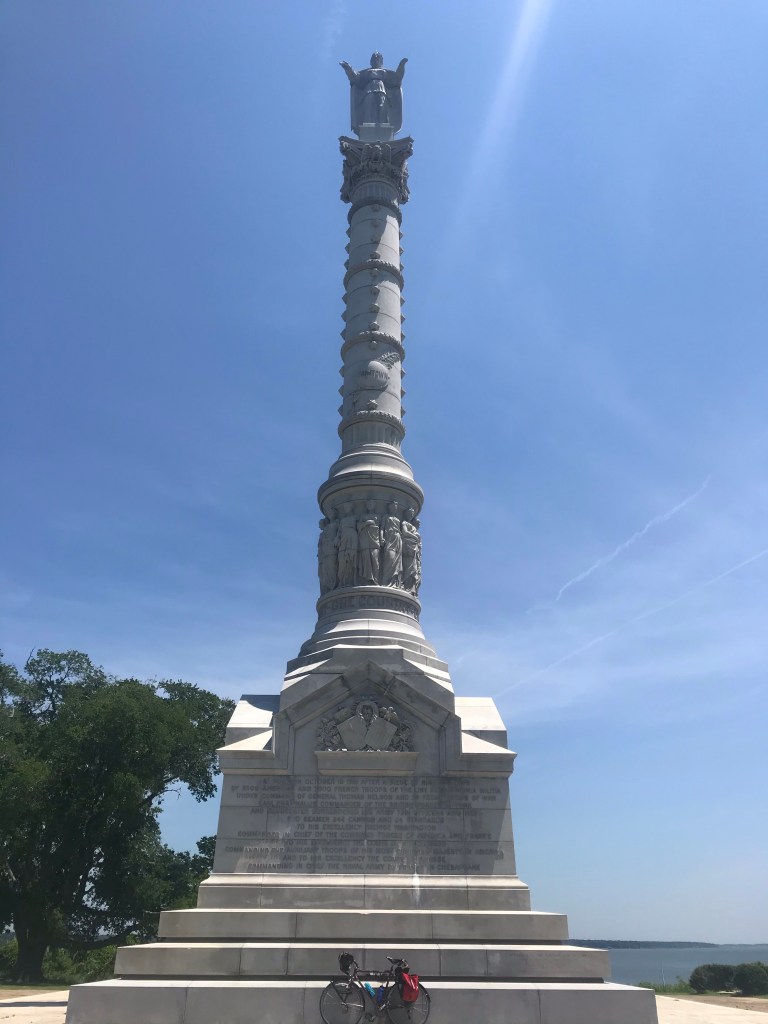
The 98-foot tall monument was erected in the 1880s. It has a massive base which supports a column topped by a figure of Liberty. (Liberty has twice been damaged by lightning, Make of that what you will.)

There are extensive inscriptions on each side of the base. These writings make clear that the Yorktown battle and siege, to a very great extent, was a French operation. It was the French navy that fought of British ships off the Virginia coast, thereby preventing an evacuation of the British army by river and sea. Of the 17,000 land forces on the American side, 5,000 were French soldiers. Without the French we Americans would spending pounds, drinking warm beer, and singing “God Save the Queen”.

And so the war ended and the new country, no longer under mortal threat from Britain, could begin in earnest.

In 1976, the year of the U. S. bicentennial, the monument became the start and finish of a new tradition of sorts. Bikecentennial was an event that sent small groups of bike tourists across small town America between the Oregon coast and the Yorktown Monument. The route they followed was named the TransAmerica Trail. It traverses over 4,000 miles through Virginia, Kentucky, Illinois, Missouri, Kansas, Colorado, Wyoming, Idaho, Montana and Oregon.

The Mule and The Monument

Fittingly, for some TransAm riders, Yorktown is the beginning. For others, it is the end. For all it is a profound experience. In 1981 I met someone who was in one of the 1976 Bikecentennial groups. Equipped with a ten-speed bike and a whole lot of heart, Anne Meng rode with six other scruffy riders from west to east. I found pictures of her group on Flickr. (Search under TAWK518, the code for their group.) They show snow, fatigue, endless roads, and joy. Oddly, she never mentioned that she crashed and spent a night in hospital in Montana.

Today, the Bikecentennial organization is called Adventure Cycling. They have mapped over 50,000 miles of bike routes in the United States. My 2016, 2017, 2018, and 2019 bike tours were nearly all on Adventure Cycling Routes including parts of the New York to Chicago, Great Lakes, Lewis and Clark, TransAm, Northern Tier, Pacific Coast, Western Express, and Atlantic Coast routes. By my count, I’ve done about 9,800 miles of their network.

After returning to Williamsburg, I headed to Jamestown Island, adjacent to the Jamestown settlement, where the ships landed. A tunnel near Jamestown village was closed to bikes, necessitating a detour into the village. It was quaint and uncrowded but for re-enactors of early colonial life and a few tourists. Back on route I rode past the Jamestown Settlement site (which I visited with my family years ago) and onto Jamestown Island. The one-lane, level road through the woods was closed to cars. Yay, pandemic.

The rest of my ride took me in a twelve-mile arc around the western side of the Williamsburg area. This was unremarkable exurban and suburban riding in blistering heat. I stopped at a gas station convenience store for drinks and snacks. Half the people in the store were not wearing masks which made me very uncomfortable and angry. I suppose causing someone to suffocate in their own blood is worth the inconvenience of wear a piece of cloth over your face.

In 30 minutes I had reached the end of my 60-mile adventure.

Bike Tour 2019

Here’s my plan for my 2019 bike tour.

Big U Bike Tour Map.JPG

I start in Chicago (or north central Indiana). I follow U.S. Bicycle Route 66, the dark blue line, to southwestern Missouri. This route follows, to the extent possible, the old Route 66 highway. I switch to the TransAmerica Route, the orange line, and head west across Kansas and the southern half of Colorado. In Pueblo, Colorado I take a day off after 1,300 miles. I’ll need it. I leave the TransAm Route and head west across the Rocky Mountains and into Utah. If I have it in me, I’ll do a side trip to Bryce Canyon National Park. I’m not planning on hiking but the scenery alone in Bryce will be hard to pass up. 

Between Pueblo and South Lake Tahoe, California, there are dozens of mountains to climb. Most of them are higher and steeper than the seven climbs I did in Montana and Washington State last summer. My maximum elevation last year as a little over 5,600 feet. This route has climbs that go over 10,000 feet. To add to the difficulty there will be long stretches with no services, including no water. And did I mention some of these will be in desert? I bought a water filter and plan on carrying extra bottled water whenever I can.

I’d like to cut weight on this tour but there really isn’t anyway to avoid carrying a tent, sleeping pad, cold weather clothing, food, and water. The best place to cut weight is from the engine. Unfortunately, I now weight 213 pounds. No bueno. I need to be under 200 by the time I leave Pueblo.

Near South Lake Tahoe, I turn north along the Sierra Cascades Route. I thought this was going to be the hardest part of the trip, but now that I have seen the elevation map of Nevada, these mountains will be a relief (so to speak). This stretch of the tour will take me past Crater Lake. Once I get into Oregon, I’ll decide whether to continue following the Sierra Cascades Route to the Columbia River. There I can turn west following the river to the finish in Portland, Oregon. An alternative would be to switch back to the Trans Am route at Sisters, Oregon, climb over McKenzie Pass, and ride down to Eugene, or even continue to the coast. Either way, I would use the Google to route me to Portland.

Since I fully expect to be a hurtin’ unit for much of this ride, I have thought about places where I can call an audible and change or curtail the tour. For instance, I can cut out the Sierra Cascades entirely and ride one last climb west across the Sierras to Sacramento or, even, the Bay Area.

I planned a two-month itinerary, the same as last year, even though the tour is 700 miles shorter. The lower daily mileage has more to do with the availability of resources than with the difficulty of the route itself. For example, when I am faced with the option of a 45 mile day or an 80 mile day, I am planning on the 45 mile day. (I generally end up riding farther than plan because riding is preferable to sitting around a campsite or a motel.)

I plan to start on May 15. The original idea was to take Amtrak to Chicago. Mrs. Rootchopper has dangled the idea of driving me to her parents’ house in northern Indiana. I can ride west and pick up Route 66 in a day or two (and avoid the traffic of northern Illinois.)

I am open for suggestions as to what to call this tour. The Big U is one idea. YODO in the Wild West is another. If you have any suggestions, feel free to add them in the comments section.

Stay tuned.


Imposter Syndrome, Nightmares, Eagles, and Maps

When I retired, I finally could say good bye to imposter syndrome. an intense, irrational feeling of inadequacy.  To some extent it served as motivation. Six months after riding solo across the country, I am doubting my ability to do a long tour. It makes not the slightest bit of sense but there it is.

For decades I have had nightmares about being in grad school. Typically, this involves forgetting to go to class (I missed only a handful of classes in college and grad school) or getting lost on campus. Last night I had a very disturbing nightmare about statistics, of all things. In my dream I had forgotten everything I knew about statistics. I felt utterly useless and defeated. I was rattled by the dream for a couple of hours after I woke up. This is totally stupid because I took statistics in high school, college, and grad school. I taught statistics at a college in Rhode Island. And statistics played a major role in my professional life.

A couple of hours after I woke up, I found a very woo woo guided meditation online. I just shut off my skeptic and went with it. It was recorded live and featured the sound of rain from a passing shower. After 25 minutes the lingering anxiety from the nightmare was gone.

Having restored my sanity, I went for a ride. I did 41 1/2 miles yesterday in shorts so I wanted to do a fairly easy 30 today.  I was meandering through suburban neighborhoods when I decided to go down a dead end street to take a look at the Potomac River. The street was lined with McMansions that go for well over $1 million. As I passed one of the last houses before the turn around, I spotted something in a pine tree. A big nest. And right above it was a bald eagle. I am guessing that he may have been guarding a brooding mama eagle.

Eagle backyard

Before my ride I called Adventure Cycling about some maps I need for my tour. The maps that would guide me across Utah and Nevada were out of stock last week. It turns out new maps will be available on Friday. So I ordered all the other maps I need. Later in the day, a couple of packages arrived. One contained a pair of hiking poles. I intend to put them to use in April and later in the summer. The other package had new tires for The Mule and a lightweight lock, which I will use instead of a heavy U-lock.

Speaking of weight, I have noticed that The Mule’s engine has added some mass in recent weeks. Time to dial back the beer and chips. Oink.