Today was the first day since the before times that we allowed our bi-weekly cleaning service back into our house. This meant that my wife and I didn’t have to spend a good part of the day cleaning. It also meant that we needed to get out of the cleaners’ way. Normally, we would go to a diner then a library. With that off the table (or booth) my wife made me an offer I couldn’t refuse. “Why don’t we drive someplace, I’ll drop you off and you can ride your bike home?”
Sounds like a plan to me.
So we jumped in my dusty Accord and drove to Purcellville, Virginia at the base of the Blue Ridge Mountains. I would ride east 45 miles on the Washington and Old Dominion Trail back to Arlington. There I’d pick up the Four Mile Run Trail for a couple of miles before turning south on the Mount Vernon Trail.
With the pandemic still in evidence, the drive to the start was uneventful. I left my wife to check out the bakery at the trailhead. (Thumbs up on the eclairs, she reports.)
I expected the ride to be mostly downhill. It is. Purcellville is at 575 feet whereas the low point of the ride near National Airport is at 15 feet. Of course there are a few long grades both up and down along the way, as well as a few abrupt rollers to keep things interesting.
What I wasn’t counting on was the headwind. Having an invisible hand on my chest put a damper on my speed. I did do a few miles at 18 to 20 miles per hour but not as many as I had hoped.
The trails were not crowded at all, except for one group of eight old folks out for a meander. Old people suck. Oh, wait….
Anyway, a few minutes delay is not much to complain about.
I had two small energy bars left over from my 50-States Ride goodie bag. That’s all I ate. I was surprised that I didn’t bonk. I also drank two large water bottles. Maybe my modest intake is to blame for the cramps that came on during my post-ride stenosis physical therapy session.
Outside Purcellville I saw a momma and a young deer. They were too shy to be photographed. Later I saw a Dad with his daughter examining a box turtle that had inched onto the trail. My final critter of the day was a rather large groundhog that was standing at attention a foot off the trail in Vienna. It seemed not the least bit concerned about me as I rode past.
The trees are turning. I had hoped for more reds but today offered more browns and yellows. One big leaf decided to hitchhike on my front wheel causing a racket when it got stuck between my tire and fender.
I was sorely tempted by the breweries and brew pubs along the trail. There seems to be one every five miles or so. You could get a serious buzz on if you stopped at each one.
East of Vienna the trail is undergoing work. There’s a detour that I couldn’t quite figure out but once I got straightened away, I found it: a on-road protected cycletrack (two lanes, one in each direction). Well done. In Falls Church city, the trail is being doubled to accommodate traffic. (I wonder if people opposed the trail when it was being built, thinking nobody will use it. Can’t imagine what they’re thinking now.) The detour around the construction is on road and unprotected. There’s hardly any car traffic so no worries.
At the eastern end of the Falls Church construction is a new bridge that will take the trial over North Washington Street and do away with a dangerous at-grade crossing. It looks like the bridge is nearly done. It’ll be a huge improvement.
Back on the street near home, drivers weren’t allowing me to move over to make a left-hand turn. I kept riding straight and overshot my turn. Before doubling back I could see the line for early voting at the government center down the street. Yesterday the line extended nearly a half mile along the sidewalk. Today, it was considerably shorter but my wife says that’s because people were a bit more bunched together. These two days brought to mind the lines at the polling place on election day 2008 when the prospect of the first black president brought an incredible turnout.
It’s been a while since I did a point-to-point ride, the stuff of bike tours. DC-area trails are limited in coverage and connectivity but if you play your cards right you can ride 57 miles and do 54 1/2 of them without a big metal thing breathing down your neck. Not a bad way to avoid a cleaning crew if you ask me.
Numbers. They seem to crop up over and over today. So let’s begin.
Banking gone bonkers
I had an 18-month CD mature yesterday. I forget what the interest rate was but it was definitely more than the bank is offering for an 18-month CD now. So I went to the bank to see what my options were. As it turned out, the best deal I could get was for an 11-month CD at 0.6 percent. Give them your money for longer and they penalize you. Hmmm.
This is quite a shock to someone who saw rates of 20 percent on six-month CDs at Rhode Island savings and loans in the early 1980s. Brown University had a policy whereby it would loan students money interest free for six months. So enterprising students would get their free loan, walk down College Hill to downtown and buy a 20 percent CD. Easiest $1,000 they ever made.
The tale does not end so well. State chartered S & Ls were insured by a bogus state insurance fund. The fund went belly up and the S & Ls (and their share holders) went belly up with them. The Reagan years had their charms.
The biggest mail day of the year
Did your mailbox seem unusually full today? Ours did. We had 26 pieces of mail, 17 letters and nine catalogues. I’ll bet you didn’t know that the day after the Columbus Day holiday is the Postal Service’s biggest volume day of the year. (With the well publicized disruptions in service this year, the jackpot in your mailbox might be distributed over the next few days). I felt really bad for our letter carrier. He’s going to need some serious pain relief tonight.
This reminds me of how my mother, who grew up in central New Jersey, used to “take care of” the mailman and the newspaper delivery boy and others at Christmas time. “Take care of” is New York City jargon for giving them some cash at the end of the year.
You’ll like our dentist. Or not.
Our daughter has been grousing about her dentist. He seems to try to sell her things (e.g., a mouth guard, Invisiline braces) that she doesn’t want. It really stresses her out. My wife and I love our dentist so we told her to check him out.
Today was the day. After her cleaning and x-rays, the dentist examined her mouth. Then they had a chat. “Why did you leave your old dentist?” My daughter explained getting stressed out by his up-selling. Our dentist then explained that he never does that. If you want to discuss products or services, he’ll happily do so, but he doesn’t believe in hard sell tactics. Then he broke the news. He found five cavities. Derp.
Why I wear a mask while riding
I know that the odds of getting covid (or any other disease) is tiny when I am riding my bike. Being in several high risk groups, I wear one anyway just to be on the safe side. Today I found a second reason to wear a mask.
Back when I was commuting or riding to night games at Nationals Park, I would ride home in the cool of the evening or nighttime. The ride along the Mount Vernon Trail from DC to my home in Mount Vernon is usually pretty splendid, but, when conditions are just right, I can find myself riding through clouds of midges. Billions of them. Midges are tiny flying black bugs. They get in your hair, eyes, nose, ears, and mouth. They also stick to your arms and your clothing.
It’s gross.
You’re riding along enjoying the cool air when suddenly
ACK, SPIT, AYYY, GAG!!!!!
You struggle to maintain control of the bike. You have to wipe the bugs out of your eyes and brush them off your arms and legs and clothing. And then you take a swig of water from your bottle and rinse out your mouthful of the little beasts.
Dis. Gus. Ting.
Did I say how gross this is? The best you can say about the experience is that midges are free flying protein.
Today, I was buzzing along on the MVT when I rode into a swarm. A few got in my eyes. Dozens stuck to my shirt. My mouth, however, was saved from the onslaught by my face mask. Pandemic for the win!!!
Somehow the weather in the DC area has been nearly perfect for about two weeks. Temperatures in the 60s. Low humidity. Sunny days with puffy white clouds (mostly). You’d think that I’d be out riding sixty-mile days one after the other but you’d be wrong. This is perfect sleeping weather. Having endured over 8,000 miles of bike riding so far this year, my body is making full use of the opportunity to re-charge itself.
Still, I’m out there nearly every day, spinning away for three or four hours. I’ve pretty much carved a rut in the roads and trails near home. I’ve been watching the trees closely. Only now are the leaves starting to turn. There are a few showoffs here and there but green still predominates.
Today was pretty typical. I rode my Cross Check across the Woodrow Wilson Bridge (I-95 and I-495, or more familiarly the Beltway) into Maryland. Then a half mile up Oxon Hill. Once at the top I turned to the south and rode a bike lane through three small traffic circles. I get my thrills wherever I can find them. Then I did two 4 1/4 mile loops on Fort Foote Road. It’s middle America suburbia. Nothing to write home about but it has nice rollers and a few fun curves.
On the way back across the bridge I heard some people up ahead looking over the railing, clapping and yelling “YAY!!” I stopped to check out the scene. The people on the bridge were applauding a wedding down below on a pier. By the time I got my phone out the deed had been done and the bride (in a faded pink gown) and groom were making their exit. That’s them just after they stepped off the pier in the picture.
Wedding on the pier
When I get home from these excursions I shower, eat snacks, and settle down to read. My daughter has been supplying me with books, nearly all novels, all summer. I left this biography for last. It’s about 740 pages of small print. It’s going to take a while. Chernow is a wonderful writer but the bike rides and the weather are conspiring to knock me out every 10 or 20 pages or so.
I read Chernow’s Grant biography last year and loved it. So I have no doubt that this book will be worth the effort.
In case you were wondering, I saw the Kennedy Center production of Hamilton last year. And I saw the Disney+ filmed version a couple of months ago. I’m not really big on musicals but the stage production of Hamilton is mindbogglingly good.
I have always been fascinated by creative people, musicians especially. They spend a decade or so absorbing all kinds of influences and then there’s an eruption. Stevie Wonder in the early 1970s is a good example. How Lin Manuel Miranda went from the book which is a straightforward biography to a hip-hop musical is beyond me.
Well, it’s time to get back to Mr. Hamilton. When I’m done with this I’ll be moving back to novels. The new Nick Hornby and Fredrik Bachman books are calling me.
Since nearly every other thing I planned to do this year has gone bung, I have decided to keep one simple goal in sight: riding 10,000 miles for the third year in a row.
I found motivation and physical wellbeing to be in somewhat short supply this month. Still, with the help of the 50 States Ride and a string of 30 to 40 mile rides around town, I managed to grunt my way through 887 miles. It should have been far less because we had planned to go to Peru on vacation, but, well, you know. I would have ridden more but I wanted to watch as much Nationals baseball as possible. (I saw 59 out of 60 games and listened to the end of the 60th in the car on the way home from the 50 States.)
For the year, I’ve ridden 7,743 miles. So I have to average 752 miles per month the rest of the year. I’d say my chances are about 50-50.
After a day of riding 65 hilly miles, my legs felt like concrete. Yesterday I was walking around like Frankenstein. In a fit of sanity, I took the day off.
Today my legs felt much better. I decided to go for a spin but before I began I raised my saddle a smidgen. Small changes to saddle height and other bicycle settings can make an enormous difference in comfort. Just a couple of millimeters was all it took to calm my sore left knee. I had no pain at all during my 35-mile ride up to DC and back. The change also seemed to help my lower back.
About a mile from home, I pulled The Mule over to take a picture..
I am beginning to wonder whether The Mule will outlast me.
Most people who read my blog know that the Washington Area Bicyclists Association’s (WABA) Fifty States Ride is my favorite event of the year. This year marks the 12th time I’ve done it and each year’s ride is different. None more so than the 2020 addition this past Saturday.
For those of you late to the game, the 50 States Ride is the most ironically named gimmick ride ever. The 60-ish mile open-streets route (it changes a bit each year) takes riders all over the District of Columbia so that they ride on the streets named for the 50 U. S. states. The gimmick part is obvious. The irony is that the ride takes place entirely outside of the actual 50 states. (DC is not a state. Its residents do not have voting members in Congress, despite the fact that they outnumber at least two actual states.)
Although the ride is 62 (give or take a mile) miles long, if feels like 100 miles. Stop signs, traffic lights, traffic circles, and, well, traffic of all kinds (the streets are not closed) slow riders down. Downhill speed is forfeited at traffic lights. Uphills begin with a standing start. This means that instead of taking four or five hours, the ride takes all day. And you can cancel your evening plans because you’ll be trashed after the event. It is hard.
In every normal year, the ride begins in a park in the centrally located Adams Morgan neighborhood. In recent years the 50 States has also had shorter versions for the less insane. This meant that all 700+ participants gathered at a sign in point. Obviously, this is not doable during a pandemic.
So the folks at WABA got creative. They created shorter events for the two previous Saturdays. Then for the 50 States they established five starting points spread strategically throughout the city. Each starting point had three sign-in times, 7:30, 8:30, and 9:30. Each location and time were assign 25 riders. The only downside to this feature is that riders could not form large posses of friends. The upside was that the long lines at check in were gone. Also, in the past, the large mass of riders at the start caused congestion at stop signs and traffic lights for the first 10 miles or so. This was great for meeting people but really annoying for both participants and drivers. Another casualty of the pandemic was the loss of post ride celebration at a pizza place in Adams Morgan.
I chose to start in Meridian Hill (also known as Malcolm X) Park in Adams Morgan, a half mile from the former starting point. Other riders started in Anacostia Park in Southeast DC, Lincoln Park on Capitol Hill, and Forts Slocum and Reno in upper Northwest DC. Each of these points doubled as pit stops where riders could get snacks, water, and use a porta potty.
My History with the 50 States
I have previously done the 50 States Ride in 2006, 2007, 2010, 2011 – 2014, 2016 – 2019. In 2006, 2007, and 2010, I started alone, but ended up meeting people or chatting with old friends along the way. All my rides since then have involved posses of friends, new and old, which made for a festive day. Also, the first two or three times I did the ride, it was held in August. It was brutally hot and muggy. Thankfully, WABA moved the ride into September which often involved torrential rains. (Not this year, however.)
This Year’s Ride
To avail myself of free, on-street parking, I parked over a mile from the start. I arrived early at the 7:30 start and checked in without waiting. This year I had a posse of one, Kevin W. with whom I’ve done the ride two or three times before. Michael B. was unable to secure an early start time so he started an hour after us.
A Flat Start
We made our way west on streets wet from overnight rain out of Adams Morgan dispatching Wyoming and California without incident. After a brief downhill we began heading east picking off New Hampshire. After more easting we turned south and rode Rhode Island southwest to Vermont. (Geographic reality had no place in the 50 States Ride). Next we rode toward the White House. Security fences kept us off Pennsylvania Avenue for now. We zig zagged to the east and conquered New York. More zig zagging to the south and east found us harvesting Indiana. We circumvented the Judiciary Square area and headed along New Jersey where we took the exit for Louisiana. After a touching base in Columbia Circle in front of Union Station we back tracked on Delaware to the base of Capitol Hill.
Climbing the hill we turned southeast on Massachusetts Avenue before doubling back toward the Capitol on Maryland. 2nd Street took us behind the Supreme Court and through the Library of Congress buildings. We headed west to Washington before turning south again for Virginia. A security gate caused a brief departure from the route but we were back on track after a couple of blocks. At this point Kevin noticed that his front tire was losing air so we stopped for a repair.
With his tube patched, we headed west on Independence Avenue to 15th Street. Turning south we touched Maine before doing a nearly four mile loop through East Potomac Drive on Ohio Drive. Back on Maine we headed past the District Wharf area and down a long stretch of M Street within a block of Nationals Park.
Except for Capitol Hill, this entire 17-mile section of the route was flat, a warm-up for the hillscape across the Anacostia River.
Clockwise for a Change
At 11th Street we headed across the Anacostia River and made our way to the Anacostia Park pit stop along the river. Here Kevin noted that his tire was getting soft so he pumped up his tire. We snacked, used the blue room, and chatted briefly with my friend Josephine who had volunteered to take the early staffing shift. As we were dallying, Michael arrived. He was with a friend who wanted to ride at a faster pace than us. They were gone within ten minutes. Michael has been a part of the Rootchopper 50 States Posse for many years. Sad face.
We gave luke warm pursuit. This year, the route east of the river (EOR) was clockwise and otherwise somewhat different from the past. We wondered what surprises awaited. We followed the Anacostia River Trail to Benning Road, a high speed traffic sewer. Benning took us east away from the river, across DC 295 and into far briefly into Northeast DC. Soon we hit East Capitol Street where we picked up Texas. This section of Texas Avenue, new to the route, was a long, easy climb through a pleasant residential neighborhood transitioning to a still-uphill curvy road through Fort Circle Park. After our park ride, we rode west about a block on Pennsylvania before turning back toward the east on Alabama. The clockwise route now had us at the top of previous years’ long climb. The next 2 1/2 miles were mostly downhill.
At a stop light, an African American man at a bus stop asked to take our picture. “You’re the only white people I’ve ever seen in this neighborhood.” His joke had a point. The EOR neighborhoods were mostly black. We riders were mostly not. I pondered a bit what would happen if the shoe were on the other foot. 50 States comes with a heaping side of white privilege.
Down Alabama and a few steeper side streets and we found ourselves on level ground heading east along Mississippi Avenue. What goes down must go up Whittier. I dreaded the climb but it was not as steep as I recalled from all those downhills of years passed. Zigging and zagging to MLK Boulevard, Anacostia’s Main Street. After another long, steady downhill we found Good Hope and took it east to Minnesota.
With the EOR hills behind us we made a few more turns and came back to the river. I noticed a couple of riders about to climb a paved path up to the Pennsylvania Avenue bridge over the Anacostia. I shouted that they were going the wrong way. They would have ended up on the wrong side of the bridge. (Been there. Done that.) We all passed under the bridge then took it back across the Anacostia River.
Back to Level Ground
Around Barney Circle (maybe the goofiest name ever) to Kentucky Avenue and east through the aptly named Hill East neighborhood on the backside of Capitol Hill. Kentucky led to South Carolina which took us for the umpteenth and final time to Pennsylvania. We stopped at District Taco at Eastern Market so Kevin could get his burrito fix then headed up North Carolina to the pit stop in Lincoln Park. The ride was now only half over.
A few weeks ago, Lincoln Park was the site of protests over the statue of Lincoln standing over a slave in chains. Today, it was the site of parents and kids, playing in a playground in one spot, sitting in a wide circle listening to a singing storyteller in another. Dog owners were being walked by their dogs. DC, it’s a hellscape of anger and violence, don’t you know.
After the burrito and a tire refill, Kevin was ready to ride. I had lunched on free pit stop snacks. (Do not follow my nutritional regimen.) We left the park headed east on Tennessee until we found Oklahoma for all of a block. Next we back tracked on C Street and went this way and that out off Capitol Hill into Trinidad (not a state but a state of mind for sure) where we picked up Florida and West Virginia. (Geography in DC is rather warped.) Another mile of level ground ensued and then, after 37 1/2 miles, things got serious again.
Northeast Traffic Hell
A mile of flat West Virginia (not remotely like the actual state) led to the insane traffic circle where New York Avenue meets Montana. Around the don’t-kill- me circle and up Montana for a few blocks. We headed east for a 1 1/2 miles on 18th to the first of two hair-raising states.
South Dakota is a four-lane highway masquerading as a city street. Cars ignore the speed limit. Fortunately we were only on it for a few blocks. Despite having ridden this ride so many times, the left on Taylor Street snuck up on me. I glanced in my mirror, saw only a car in the distance, signaled, and turned left. In South Dakota, cars are closer than they appear. Kevin veered off to the right so as not to be run over by the car running up my rear wheel. I made it without harm and waited for Kevin. “That was close,” he remarked rather dryly. To our credit, neither of us wet our pants.
Taylor gave way to a dicey intersection at Michigan which we took back east. We used the sidewalk on the bridge over the railroad tracks in Brookland to Catholic University where Kevin once again refilled his front tire.
Aloha Bitches
A half-mile flat ride gave way to the bumpy climb up Hawaii Avenue. After a slight downhill and rest at a red light, we turned southeast and then east toward Petworth. A hard right and we were on Illinois Avenue heading north. Around Grant Circle and north toward the three-syllable streets. (Streets run east-west and are alphabetical, adding syllables with each turn through the letters.) After a left on Buchanan, we hung a left on Kansas and headed back to Petworth. A right on Varnum took us directly onto Iowa, right onto Arkansas, and left onto Georgia in quick succession. Georgia is another notorious DC traffic mess but the pandemic worked to our advantage by keeping traffic more or less sane.
To the Top
A left on Kennedy took us to a hard right on Colorado. Every year people seem to linger in the street at this intersection. Every year I avoid colliding with them. This year was no different. Colorado took us to Missouri. This splendid downhill was spoiled by speeding DC traffic. The left on Longfellow could not have come soon enough. Kevin spotted his friend Sam hanging in front of his house. Sam and Kevin walked a few blocks as I lolled along on my bike. We arrived in Fort Slocum for another rest stop. Here Kevin changed his troublesome front tire and I ate snacks. The snacks seemed to vaporize before reaching my stomach. Lunch would have been a good idea. I had a chat with Anna, the WABA event coordinator.
After leaving the park we headed southeast on North Dakota, which was decidedly saner than South Dakota had been. When we reached 3rd Street we turned back to the north, lefting and righting into the Tacoma Park neighborhood. We rolled past Mike and Lisa’s house where the Tacoma rest stop was before the virus. I rang my bell and waved at someone working on a bike in their garage. His mask made it impossible to ID him.
We’d now reached the northern most part of DC and turned south along Alaska Avenue. As in years past, Patty Heck was standing at the turn taking pictures of us as we made our turn south. She’s done this in all sorts of weather including downpours. Check out her pix on Flickr.
Alaska was all downhill to busy 16th Street. We took a left for a few hundred yards before banging a right through a closed traffic gate at Sherrill Drive into Rock Creek Park. To this point the day had been overcast. The sun was now fighting to break through and temperatures and humidity were rising. The shade on Sherrill was most welcome but we could have done without the wet leaves that turned the curving downhill into a nervous descent.
Was It Always This Hilly?
At the bottom of the hill we turned left onto Beach Drive in the park only to exit the other side on Bingham. Bingham has been closed for years and the roadbed has been allowed to deteriorate. It was rideable and only mildly annoying.
Next up was a left on Oregon Avenue which has been under construction and off the route for a couple of years. We took a left on Oregon. It had only one lane and of course was bumpy and up hill. Being good citizens, we pulled over after a while to let cars pass. At Military Road, another car sewer, I followed Kevin onto the sidewalk. We backtracked onto Utah and into tony Chevy Chase. If you have to ask you can’t afford it. After a turn south on Rittenhouse. we turned onto Nevada. Unlike the brutal desert basin and range of the real thing, Nevada was like a locale for Landscaping for the Rich and Famous.
We had climbed out of Rock Creek Park but the fun was only starting. At Linnean Street we went up some more. Then we took a left on Fessenden Street and climbed more. And more. And more. How did I forget about this? Really. It was looong.
We stopped at Fort Reno for a chat with WABA’s Kristin at the last pit stop. More snackage. Hey, these little cheese circles ain’t bad. And they go so well with Goldfish crackers.
A couple of blocks later we were climbing up Wisconsin Avenue over yet another hill to Tenley Circle. As we took a right onto Nebraska Avenue an impatient Mustang driver roared past us. (This was only the second aggressive pass of the day.) Mr. Mustang zoomed to a red light 100 feet later. As far as we could tell there was no cross street, just a cross walk. Karma for the gas horse.
Nebraska was flat past American University and through Ward Circle and onto Loughboro where the road turned down. A left down Arizona made for the best descent of the day. Of course, it was wasted by a red light at MacArthur Boulevard but only dreamers get the green.
Garfield Isn’t the Worst of It
We tuned left up the short hill on Ashby Street, then left to recover for a half mile on flat 49th Street. Just as the feeling in my legs returned, we took a right up dreaded Garfield Street. This sucker nearly killed me the last few years but Kevin said, “We’ve got all day.” We dropped into our granny gears and took the hill without undue pain. Then Kevin remarked, “There’s another one ahead that I really hate.”
What?
The other side of Garfield was downhill then up. The up was taken care of by our momentum. We stopped and turned left up New Mexico, a false flat. (Looks flat. Goes up. Kills your psyche.) Our next right turn took us up Cathedral Avenue. This was the hill Kevin was talking about. I think past torture on Garfield had erased it from my memory. UGH.
After the slog we turned left on 39th and crossed Massachusetts to Idaho. The good news was that we were now in Cathedral Heights, the last of the hills. The bad news was that the inside of my left knee was screaming at me. As we turned onto Macomb Street we could see National Cathedral to our right.
Starting up after a red light at Wisconsin Avenue was extremely painful. I felt like a knife was sticking in my left knee. Fortunately, the rest was downhill. A right, left, and right took us through Woodley Park onto Connecticut Avenue.
The WABA route maker always leaves this busy boulevard for last, when riders are exhausted and traffic is relentless. Except for this day. No cars! We took the left lane and sped downhill to Calvert Street where the oncoming cars let us make a left turn without stopping. My knee was grateful. After a mile we were back at the park where we started where Hannah and Chris, staffing the WABA tent, were there to congratulate us.
Fin.
A Dozen in the Books
It was a tough ride, but well worth the time and effort. Thanks to Kevin for being an excellent one-man posse. Sorry for nearly getting you killed on South Dakota Avenue.
To the participants, thanks for wearing your masks and maintaining social distance. Compliance was excellent.
The clockwise ride EOR was an interesting improvement. Somehow the same hills seemed much easier in the clockwise direction. We had to give up prior years’ screaming downhill on Pennsylvania Avenue, but it was well worth it.
Big thanks to the volunteers and WABA staff, especially the early shift who woke up before 5 a.m. and set up the starting points/pit stops in the rain.
Congratulations to the WABA team for creatively re-imagining this event. It worked! Unfortunately, the social aspect of the ride suffered but your hard work salvaged and, in many ways, improved the event.
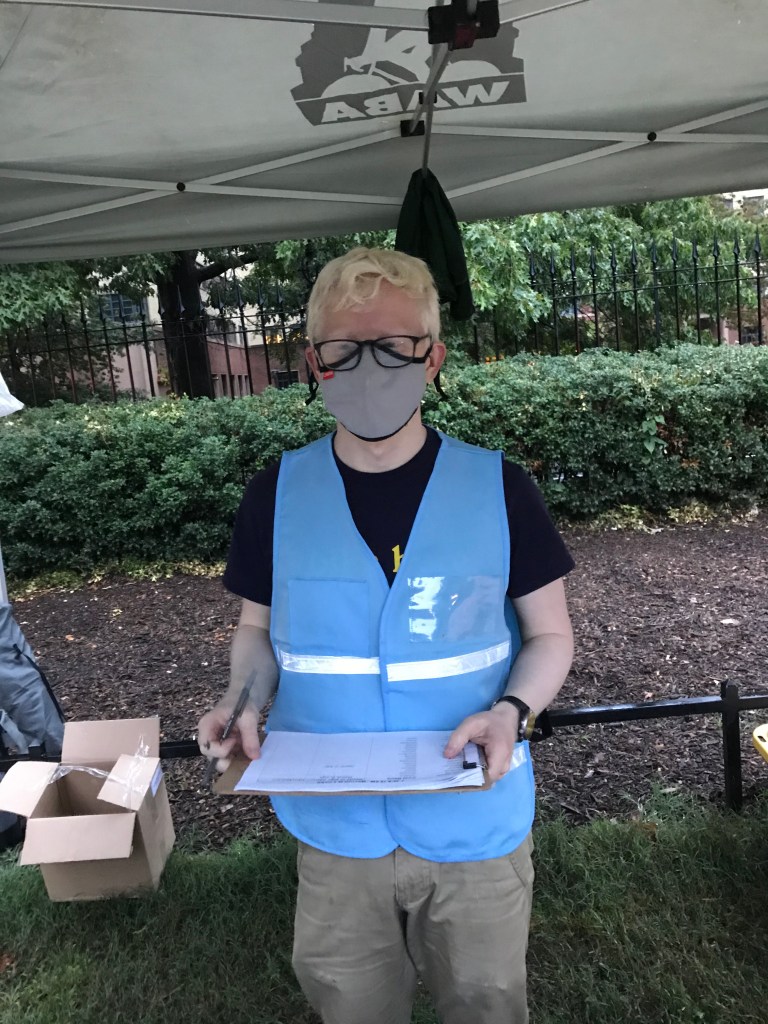
WABA’s Garrett Hennigan at the start in Meridian Hill Park
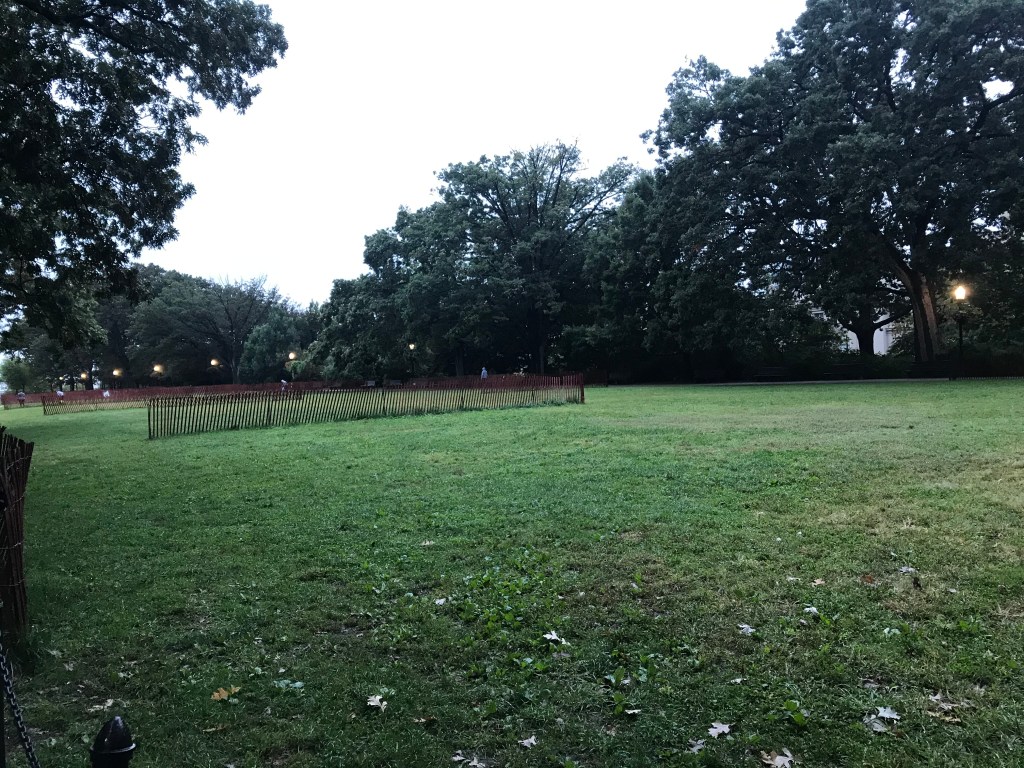
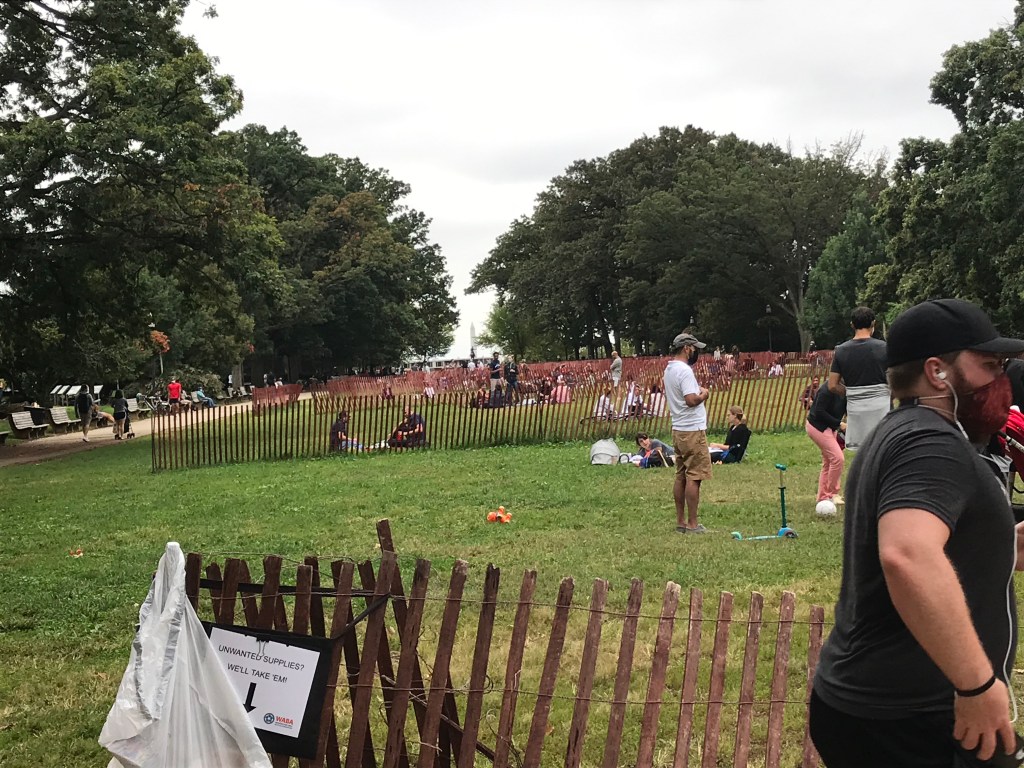
Meridian Hill Park before the start
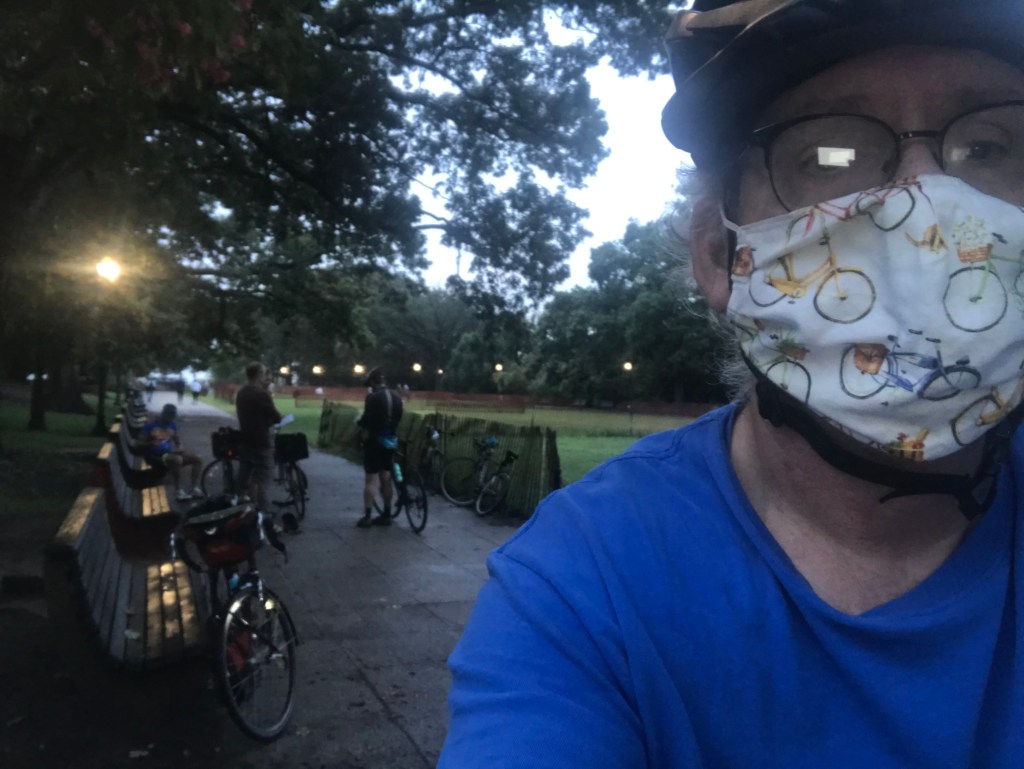
Me. Ready to ride or rob a bank,
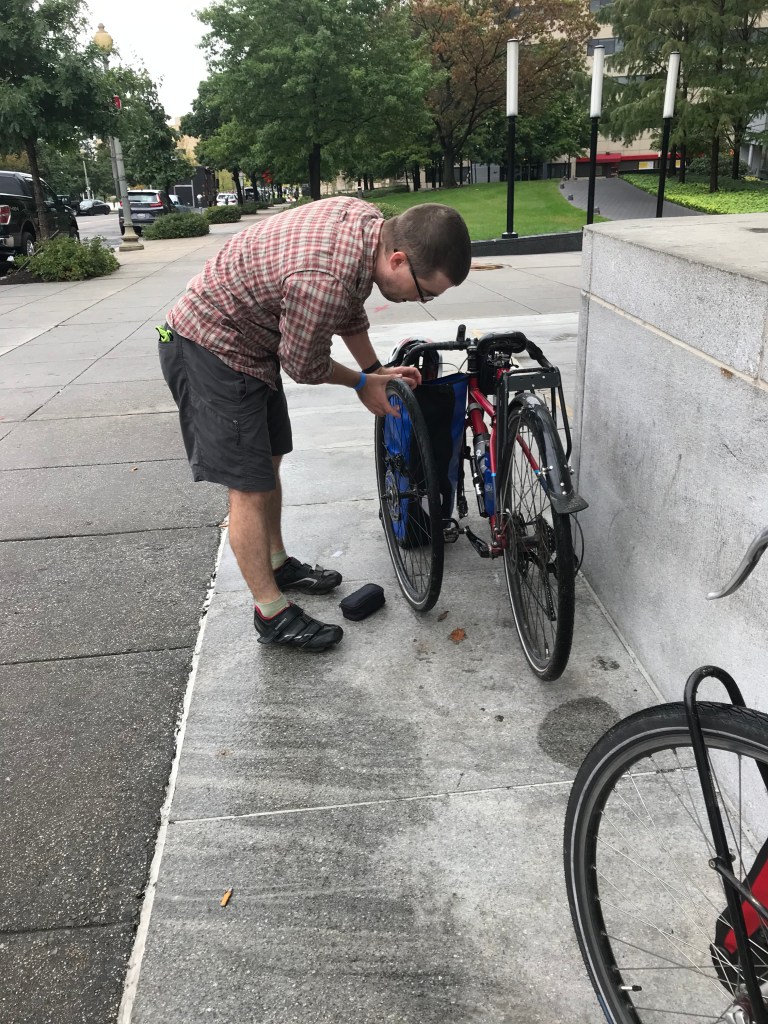
Kevin and his front wheel
Michael and friend at the Anacostia pit stop
Josephine at the Anacostia pit stop
Kevin’s lunch stop
Statue of Mary McLeod Bethune in Lincoln Park
WABA’s Anna at the Fort Slocum pit stop
WABA’s Kristin at the Fort Reno pit stop
Meridian Hill Park after the ride
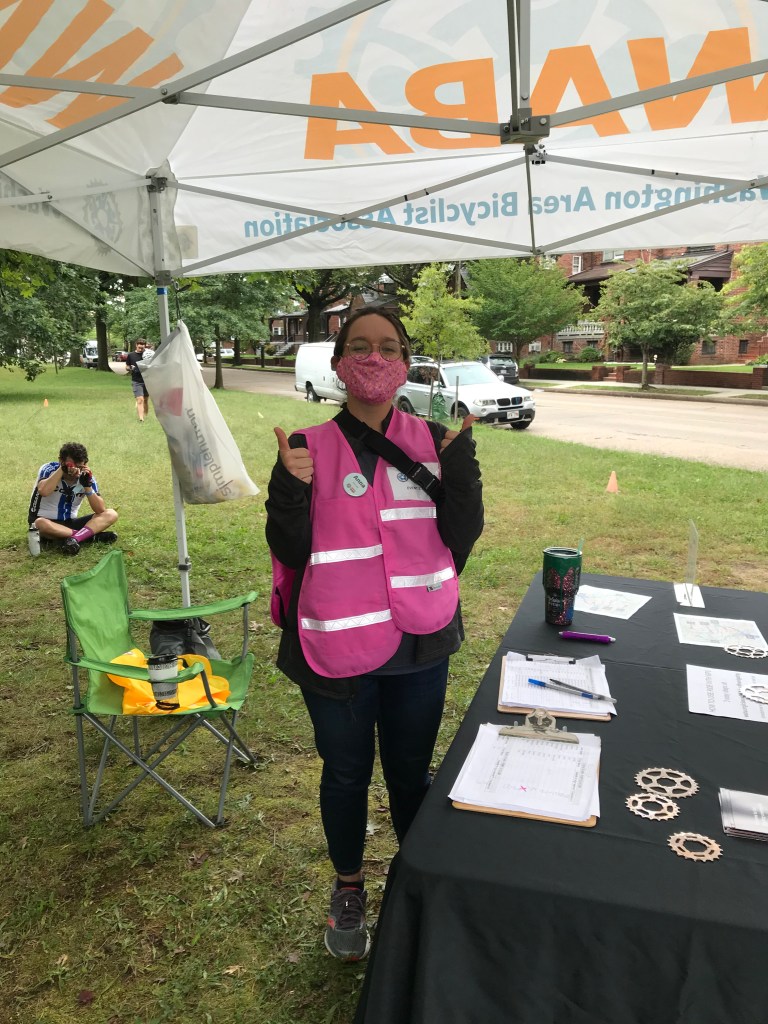
WABA’s Hannah and Chris at the finish in Meridian Hill Park
I haven’t been very good about taking pictures lately so here are a few things that caught my eye on recent rides around home.
I was crossing the 14th Street Bridge into DC when I spotted a velomobile headed in my direction. I couldn’t get my camera out in time for a shot of the front but here’s the driver as he passed me.
After he went by I noticed that the roof of the “car” was covered with solar cells. And to he was pulling a trailer with additional solar cells. As you can see it’s a bit wide for the bridge trail but we managed not to collide.
You can also see the small American flags that have been duct taped to the side barrier at intervals. A volunteer has been doing this every year as a tribute to those who lost their lives on September 11, 2001. If you squint and look to the left of center just above the railing on the barrier you can make out the Pentagon and the three curved spires of the Air Force Memorial. The Memorial was constructed after 9/11. It is more or less in the flight path of the hijacked plane.
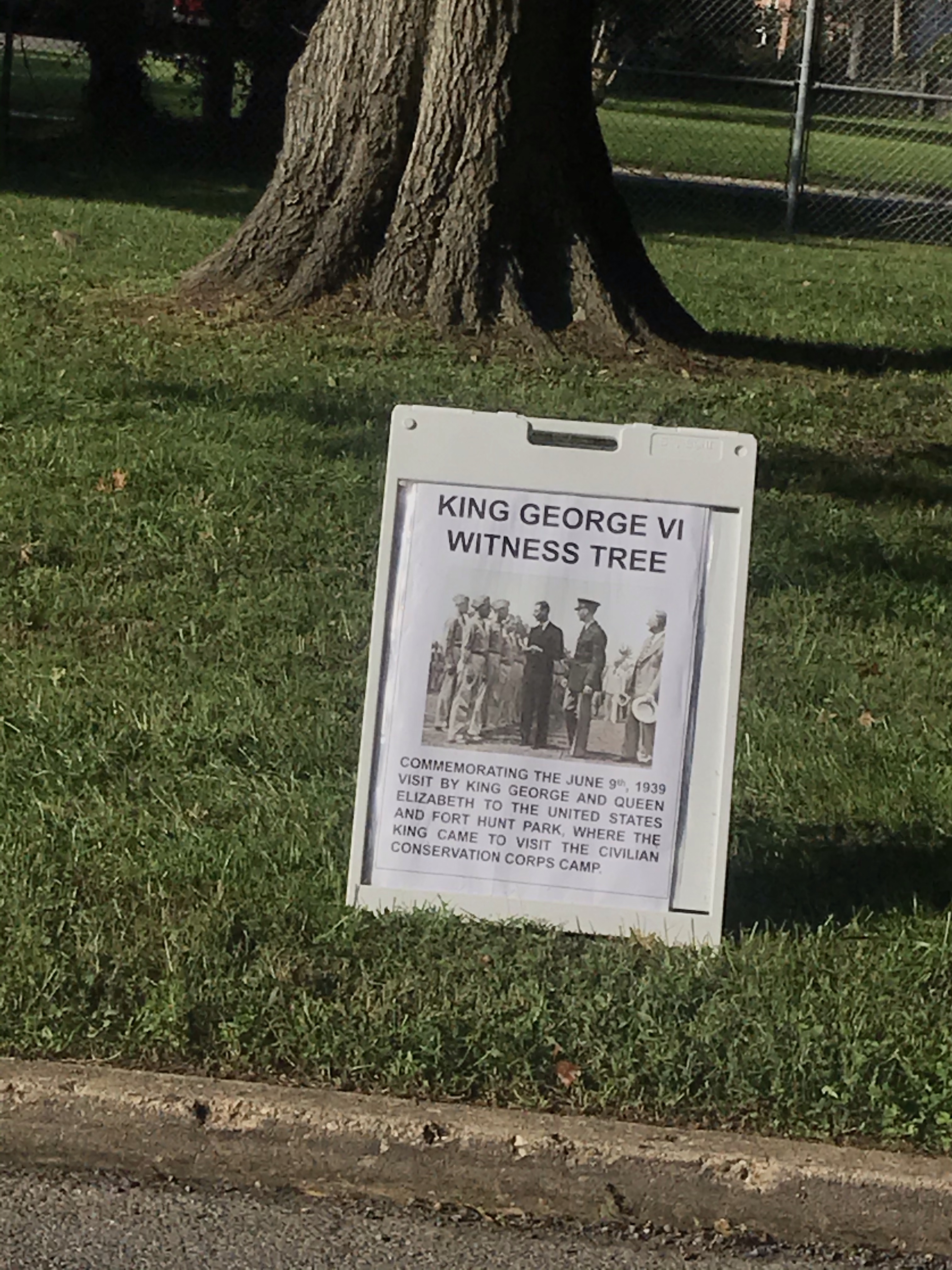
I live near Fort Hunt Park. There is a 1 1/4 mile paved circuit road in the park that I often use when I want to let my brain wander having to worry about fast moving big metal things. The other day I noticed people stopping to read this sign. It explains that in 1939, just before all hell broke loose in Europe, King George VI came to check out the Civilian Conservation Corps operation in the park. They planted a tree in his honor.
Here’s a close up of the sign.
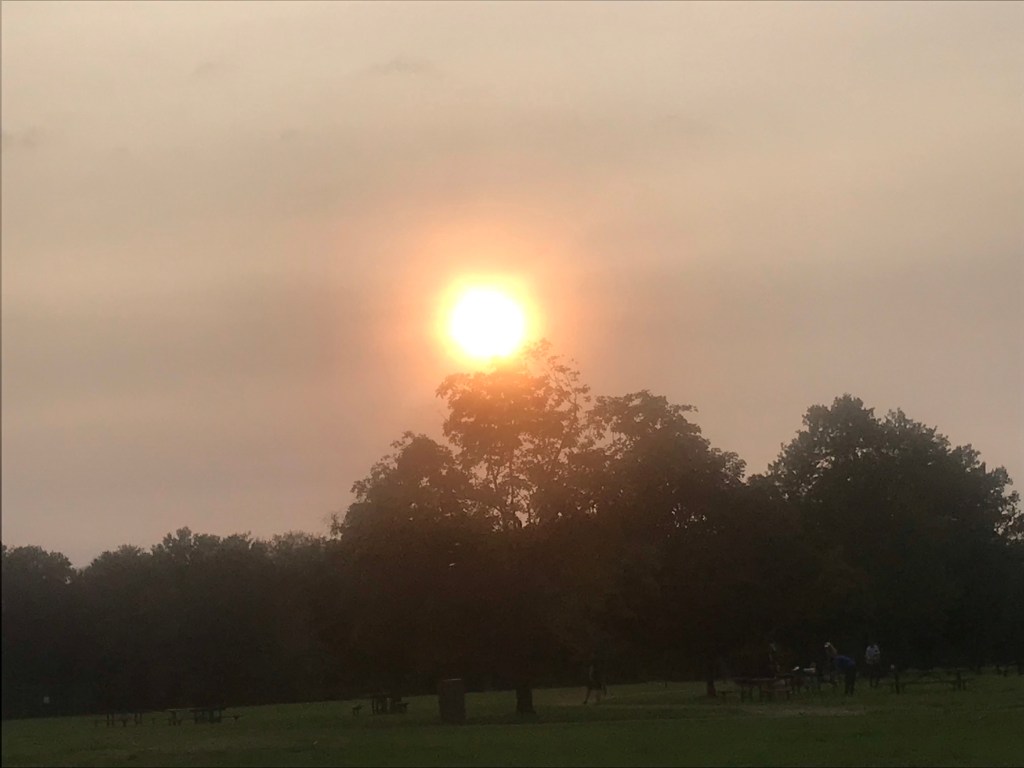
This evening I went to the park to ride around in mindless circles. It was a beautiful evening. Park of the reason the temperature was so agreeable is the fact that a haze is blocking some of the sunlight. The haze is caused by wildfires out west, over 3,000 miles away.
I have a condition known as spinal stenosis. This is the narrowing of the pathways around the spinal cord and the nerves that branch off of it. Some of the nerves get irritated causing pain. My pain primarily shows up in my lower left leg. It is a dull ache that gets worse when I walk or stand. Last winter my pain was so bad I couldn’t walk across a room. As is typical of spinal stenosis, I can ride a bike without any pain at all.
To treat the pain I had cortisone injections in my back. The injections were very painful. The shot goes into the already irritated nerve and an electrical shock shoots down the nerve all the way to your toes. After a couple of days, the stenosis pain went away. The analgesic effect of my shot lasted about six weeks. Then covid hit and my doctor left the practice I was using.
When the dull ache returned this summer, I decided to wait a while to see if it would go away. My activities included riding my bike, reading, watching baseball, cleaning the house, and mowing the lawn. Mowing the lawn is not a problem because it involves supporter walking with a forward lean. The forward lean decompresses the spin so as not to irritate the Inflamed nerve. Only house cleaning and trimming the grass caused pain, both because they involve unsupported standing and walking.
I’ve also been doing physical therapy. I searched YouTube for appropriate exercises. Recently I added a few. They take about 15 minutes to do.
About three weeks ago, the pain became much greater so I called for an appointment. After a couple of insurance-related hassles, I ended up seeing a nurse practitioner.
Yesterday I mowed the lawn without pain. Then I used a trimmer and a blower. I expected that walking around with the trimmer and blower would cause my leg pain to flare up. It didn’t.
Going to a doctor without symptoms seemed pointless, so I decided to walk the half mile to her office. I brought a cane, just in case. About 100 feet into the walk, my left calf started aching. On a scale of 1 to 10, with 1 being mildly annoying pain and 10 being just-shoot-me, my pain was a 1. I expected it to increase as I walked but it either stayed the same or went away entirely, The only abnormality was a slight awkwardness to my gait.
I explained to the nurse that I made this appointment with the intention of getting a shot. Obviously, a shot was not necessary.
All was not wasted, however. We set up a plan. I will test my back by going for a short, east hike. Three miles should do the trick. If the pain returns and lingers then I call her and she’ll get the insurance authorization and set up the injection appointment with the doctor.
We also discussed how to deal with activities like vacations and such. If I expect to be doing a lot of walking, she will prescribe pain medicine as appropriate. Sadly, because I live in Virginia, she cannot prescribe marijuana edibles. With appropriate levels of THC, they work extremely well with little to no side effects.
I walked home without a problem. Then I went for a 30-mile ride.
Before going on a bike ride, experienced bike riders always check the weather report. When I woke up this morning the reports called for heavy rain all day. Then, just a little before I left on my ride I saw this report from the @capitalweathergang on Twitter:
DC area forecast update, 10a: Radar shows very little rain in the region and the forecast for today has improved. We no longer expect widespread heavy downpours. Just hit or miss showers. Some could be heavy later on but dry more often than not.
I left the house into the slightest of sprinkles. No problem. Within 2 miles of home the rain started falling more heavily. No problem. A raindrop managed to make it into my right eye. Sting. Can’t see. Problem.
The rain intensified. Now I am riding in a downpour with raindrops all over my glasses and one eye pretty much out of commission. Just before descending a half mile hill on Fort Hunt Road, I pulled over to get the sting out of my eye. I realized that the best way to keep this problem from recurring was to lower my forehead to keep my eyes under my helmet’s visor. It worked but I had to keep my speed down below 10 miles per hour. At this speed I look over the top of my glasses and see about thirty yards ahead, enough to avoid crashing into the construction worker’s pick up truck parked on the shoulder in the middle of the hill.
This was the hardest rain I’ve ridden in since Iowa on my 2018 bike tour across the country. I was riding downhill at over 30 miles per hour. My old cantilever brakes were utterly useless. It was terrifying. Last year I replaced them with mini-V brakes at the suggestion of a mechanic at my local bike store. As it happens, I did some maintenance on them before yesterday’s ride so they were ready for today’s challenge.
Speaking of local bike stores, mine caught fire last year and has been closed ever since. I turned off Fort Hunt Road to check out progress on its re-construction. I am happy to report that there is now a roof on the place and some framing for walls inside. Yay, progress.
I’d have taken a picture but the rain was coming down in sheets. Ugh.
I continued northward along Fort Hunt Road and took a trail over to South Washington Street in Alexandria. At South Washington Street I pressed the beg button to cross the street. I rested over my handlebars while waiting for the light to change. My back felt like I was in the shower at home. The rain was just pelting down even harder.
After a short descent I stopped underneath the Woodrow Wilson Bridge. I was a tad moist.
Here’s a shot of the playing fields to my immediate right in Jones Point Park. The Potomac River is just beyond those trees.
I continued into Old Town Alexandria down Union Street. At King Street things look a tad damp.
Flooding here is pretty common. What’s not clear from the picture is how fast the water is running toward me on the left side of the road. No sooner had I taken this picture than the rain intensified again.
I escaped uphill via an alley and re-connected with the Mount Vernon Trail on the north side of Old Town. I continued on the trail to the Four Mile Run Trail near National Airport. I turned off at Four Mile Run and made my way to the chicane that connects to the Potomac Yards Trail. The adjacent staircase was a waterfall.
I followed this trail back south. When I came to the trail head at Braddock Road I could see water gushing off the adjacent playing fields rail. The water cut right across the trail and down the curb cut into Braddock Road. (In the photo below, this is at the yellow sign on the right beyond the bridge.) I rode into this water and quickly realized that it was over a foot deep. Dang. Not wanting to pedal into a submerged obstruction I dismounted and started to walk up Braddock. The water was running fast and within two steps it was up to the top of my knees. (If the components on The Mule could talk they’d be pretty pissed off at me right about now.) After about 50 yards I reached dry-ish ground. The rain had abated. I stopped to take a picture of some pedestrians trying to get down the street I had just walked up.
Thankfully, the rain lightened. I headed back home. I swung by River Farm, the home of the National Horticultural Society. I turned in to ride the half mile loop and was rewarded with a close encounter with three turkeys. I decided to call them the Capital Weather Gang. They were spreading their wings to warn me off so I kept my distance.
A mile from home I could see a large dark cloud forming over my neighborhood. I called it a day after 28 miles. Apparently the cloud moved away. It hasn’t rained since I put my bike away.
For what it’s worth the area I was riding in had two to three inches of rain. Hyattsville, Maryland about 25 miles to the north had six inches!
Today was my appointment with my new pain doctor. I arrived on time. I was given forms to fill out, of course. As I was filling them out the receptionist called me to her work station. It turns out the pain doctor who is new to this practice has yet to be approved as an in-plan doctor by my insurance company.
Why didn’t they tell me this three weeks ago when I made the appointment? I had the option of seeing an in-plan physicians assistant a week ago but insisted on seeing an MD.
So I was given three choices:
(1) Book a new appointment with another in-plan doctor (which would probably have delayed my treatment by another three weeks).
(2) Pay the out-of-plan rate to see my new doctor today. (Hey, what’s $600 between friends, right?) Or,
(3) Make an appointment to see the physicians assistant on Monday of next week.
It was like being on Let’s Make a Deal. I chose Door No. 3. They assured me that the PA was authorized to order cortisone injections.
While I was there I asked them if they kept a copy of my MRI. Nope. So my first order of business was to go home and dig it out of my files.
Ironically, I am not in pain. Somehow, for the last four days or so, the referred pain in my leg went from a 9 on a scale of 10 to a 1.
What’s behind this?
Well, first of all, other than riding my bike and mowing my lawn I hardly do anything but sit. Mowing the lawn doesn’t cause any pain because it involves supported forward leaning, just as riding a bicycle does. I did some housecleaning (bathrooms, vacuuming and such) last Thursday. Since this activity did not involved forward leaning, leg pain increased.
Another possibility is that I have made some modifications to the physical therapy exercises I’ve been doing. I doubt this is having such a big effect though.
My final thought is that I have been riding The Mule consistently for over two weeks. The Mule has easy gears and absorbs road shock well. In contrast, my CrossCheck has aggressive gears. My Bike Friday doesn’t absorb road shock. And my Tour Easy recumbent does not involve leaning forward.
The time is now for me to get this back issue squared away. I want to be able to walk around like a normal person, perhaps even do a day hike now and then.









 A Few Spokes Shy of a Wheel